An appliance depreciation schedule can mean two different things. One is the tax schedule on your return. The other is a useful-life schedule that sets fair move-out charges and insurance values. This guide separates them.
What an appliance depreciation schedule means
Ask a CPA for an appliance depreciation schedule and you will get a tax document: what you bought, when it went into service, and how much you deduct each year. Ask a property manager and you will usually get something else, a list of how long each appliance should last and how much of that life is used up.
Both are real, and both use the word depreciation. They answer different questions, follow different rules and should never be swapped. The tax schedule is set by the IRS. The useful-life schedule is your own estimate of how long an item lasts in your units.
Searches for appliance depreciation rental property usually mean the tax version, but operations needs the other one too. This guide covers depreciation of appliances in rental property from both sides. It is general information, not tax or legal advice. Confirm tax treatment with a CPA.
Two kinds of appliance depreciation schedule: tax vs useful life
| Tax depreciation | Useful-life depreciation | |
|---|---|---|
| Purpose | Deduct the cost of an asset over time on your tax return | Estimate remaining value for move-out charges, insurance values and capital planning |
| Who sets the rules | The IRS and the tax code | You, based on manufacturer data, industry studies and your own units |
| Time period | A fixed recovery period by property class | An expected life per item, which you can adjust |
| Starts when | The property is placed in service: ready and available for its use in the rental | The install date |
| Who owns it | Your CPA or tax preparer | Property management and asset management |
Confirm tax treatment with a CPA. Rules and elections change.
How the IRS treats depreciation of appliances in rental property
IRS Publication 527, Residential Rental Property, says appliances, carpeting and furniture used in a residential rental real estate activity are 5-year property under the General Depreciation System. Under the Alternative Depreciation System, the period for these items is 9 years. The building itself is different: residential rental property is depreciated over 27.5 years, straight line, with a mid-month convention.
Depreciation begins when you place the property in service. Publication 527 describes that as when it is ready and available for a specific use in the rental activity. That is not the date you bought it, and it is not the date a resident moved in.
The publication also separates repairs from improvements. A repair can be deducted. An expense that betters, restores or adapts the property must be capitalized and depreciated. Whether a replacement counts as a repair or an improvement, and whether a safe harbor applies, is a question for your CPA, not for a maintenance report.
An example appliance depreciation schedule for useful life
The life column comes from the NAHB’s 2007 study of home component life, which surveyed manufacturers and trade groups. The study calls its figures general guidance, not guarantees. The cost and per-year columns are illustrations only.
| Item | Expected life (years) | Example replacement cost | Straight-line value used per year |
|---|---|---|---|
| Refrigerator, standard | 13 | $1,200 | about $92 |
| Range, electric | 13 | $900 | about $69 |
| Range, gas | 15 | $900 | $60 |
| Dishwasher | 9 | $600 | about $67 |
| Microwave | 9 | $300 | about $33 |
| Washer | 10 | $800 | $80 |
| Dryer | 13 | $750 | about $58 |
| Water heater, gas | 10 | $1,100 | $110 |
Example costs are illustrative. Use your own purchase prices and your own expected life where it differs.
Do not mix the two schedules
A refrigerator is 5-year property for tax purposes, yet it may last 13 years in your units. Fully depreciated on paper does not mean worn out. A tax schedule that hits zero in year 5 tells you nothing about what to charge a resident in year 7 or what to insure it for.
The useful-life schedule works the other way. It says a 4-year-old refrigerator with a 13-year life has about 69% of its life left. That is the number a fair move-out charge needs.
Keep the two apart in your records. Let the CPA own the tax schedule. Let operations own the useful-life schedule, and keep install dates on every item so both can be built from one set of facts. For lifespan data by item, see the guide to appliance life expectancy.
- Tax life: set by the IRS class for the property
- Useful life: your estimate for each item
- Both start from the same install date
Where an appliance depreciation schedule earns its keep
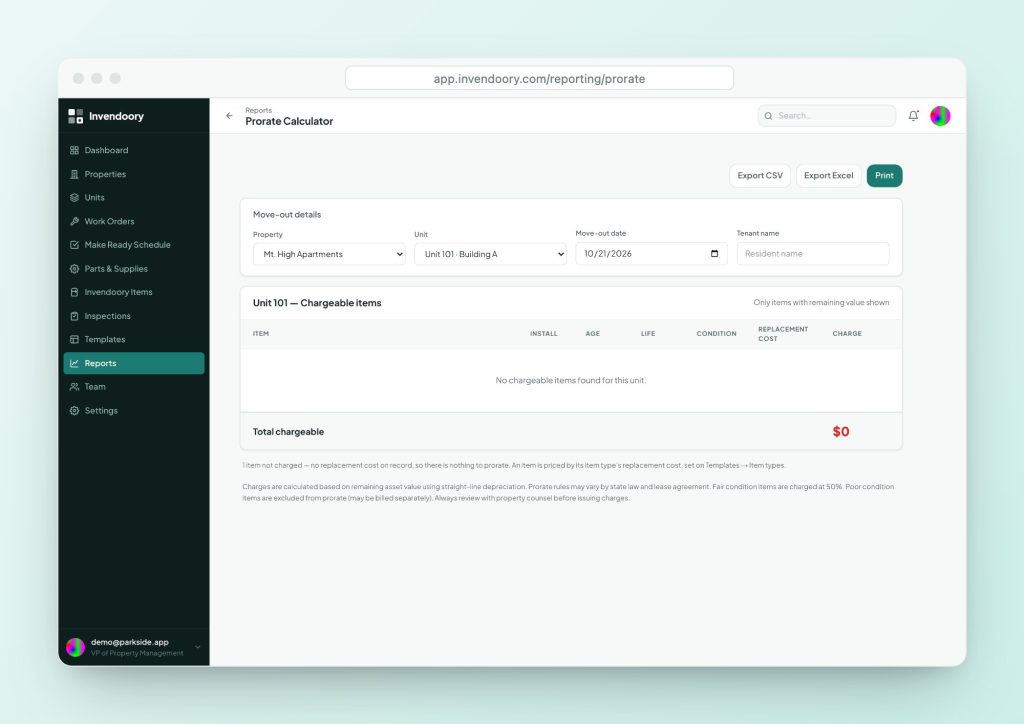
Two jobs depend on it. The first is move-out charges. The free appliance depreciation calculator runs the math on one item, and the Prorate Calculator uses straight-line depreciation: replacement cost x remaining life x condition factor, rounded to the nearest $50. Excellent and Good items count at 100%, Fair at 50%, and Poor items are left out of the total.
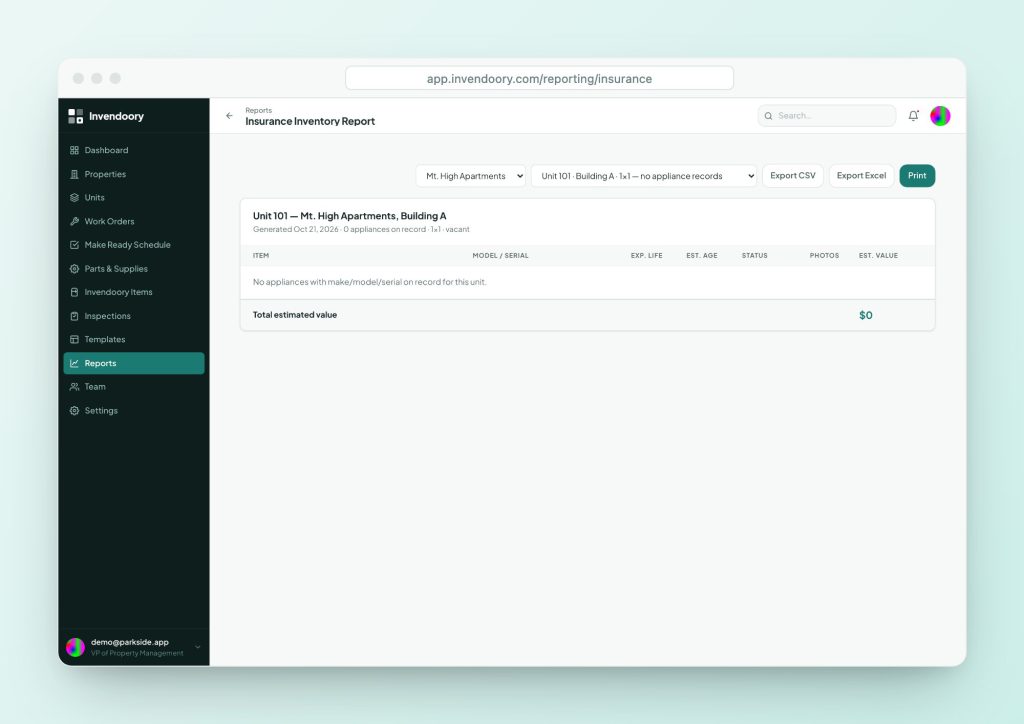
The second is insurance. The Insurance Inventory Report lists each item per unit with model, serial, age, expected life, status and an estimated depreciated value. It supports an insurer’s conversation about contents and building components. It is an estimate based on age and expected life, not an appraisal.
Neither report replaces your tax schedule. Invendoory does not calculate tax depreciation and has no accounting sync.
- Prorate Calculator: age, life and condition set the charge
- Insurance Inventory Report: estimated depreciated value per item
- Exports to CSV and Excel for your CPA or broker
How to build an appliance depreciation schedule
1. Record install dates
Without a date, an item has no age. Capture make, model, serial and install date for each appliance.
2. Set an expected life
Start from a published figure such as the NAHB study, then adjust for your climate, resident turnover and service history.
3. Track life used
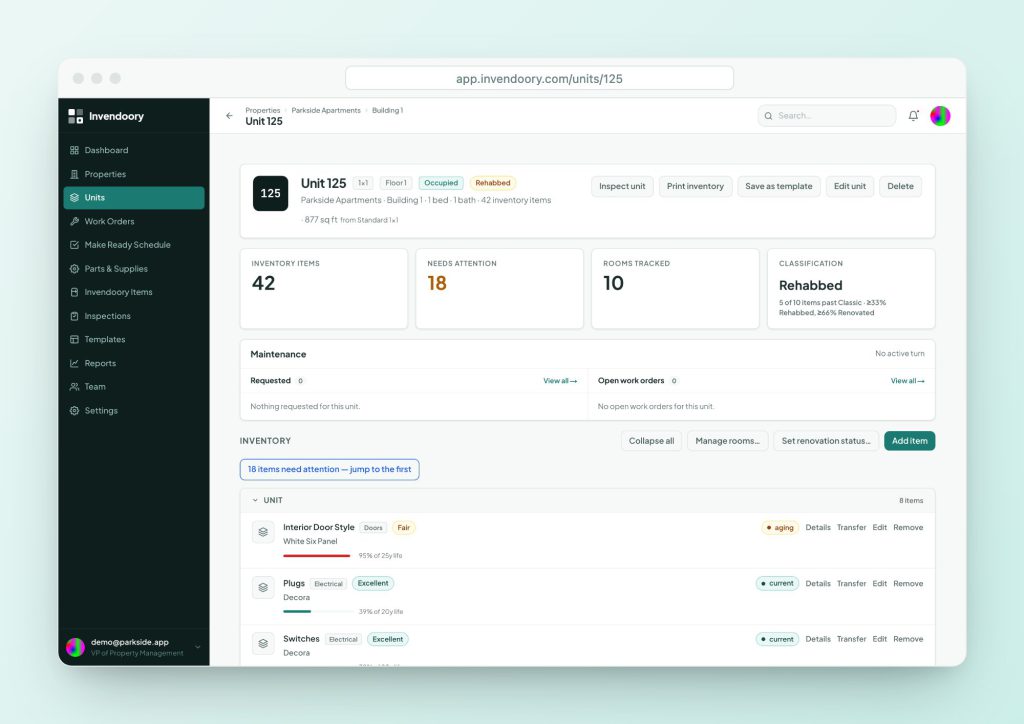
Age divided by expected life gives life used. Invendoory shows it as a bar: green under 60%, amber at 60-80%, red above 80%.
4. Update on replacement
When a turn is verified or a replacement is completed, the unit’s inventory updates itself, so the schedule resets for the new unit.
One record feeds the whole appliance depreciation schedule
Once install dates and expected life live on each item, the same data answers several questions. Make ready updates what is installed. The asset inventory shows years left per item, which helps with replacement planning. Reports export to CSV and Excel, so your CPA can read the same list you do.
The useful-life schedule is only as good as the dates behind it. Missing install dates are the usual gap, and they are the first thing to fix.
Appliance depreciation schedule questions
How many years do you depreciate appliances in a rental?
IRS Publication 527 treats appliances, carpeting and furniture used in a residential rental activity as 5-year property under the General Depreciation System, and 9-year under the Alternative Depreciation System. Elections and exceptions exist, so confirm your schedule with a CPA.
Is a replacement appliance a repair or an improvement?
The IRS draws the line by whether the expense betters, restores or adapts the property. Replacing a whole appliance is often capitalized, but safe harbors may apply. Your CPA decides the treatment, not your maintenance team.
Why is my appliance fully depreciated but still working?
Tax depreciation follows a fixed recovery period, not the appliance’s real life. A refrigerator can be fully depreciated at 5 years and still run for 13. That is why a separate useful-life schedule matters for charges and insurance.
Which schedule should I use for move-out charges?
The useful-life schedule, based on remaining life and condition. Tax recovery periods do not reflect how long an item actually lasts. Check your state’s deposit rules and have counsel review your method.
Does Invendoory produce my tax depreciation schedule?
No. It tracks install dates, expected life and estimated depreciated value for operations and insurance. Tax depreciation stays with your CPA. Reports export to CSV and Excel so you can hand over the item list.
Sources
- IRS Publication 527, Residential Rental Property (Recovery periods, placed-in-service rule, repairs vs improvements.)
- NAHB, Study of Life Expectancy of Home Components (2007) (Expected life figures in the example table. The study states they are not guarantees.)
Checked October 2026.