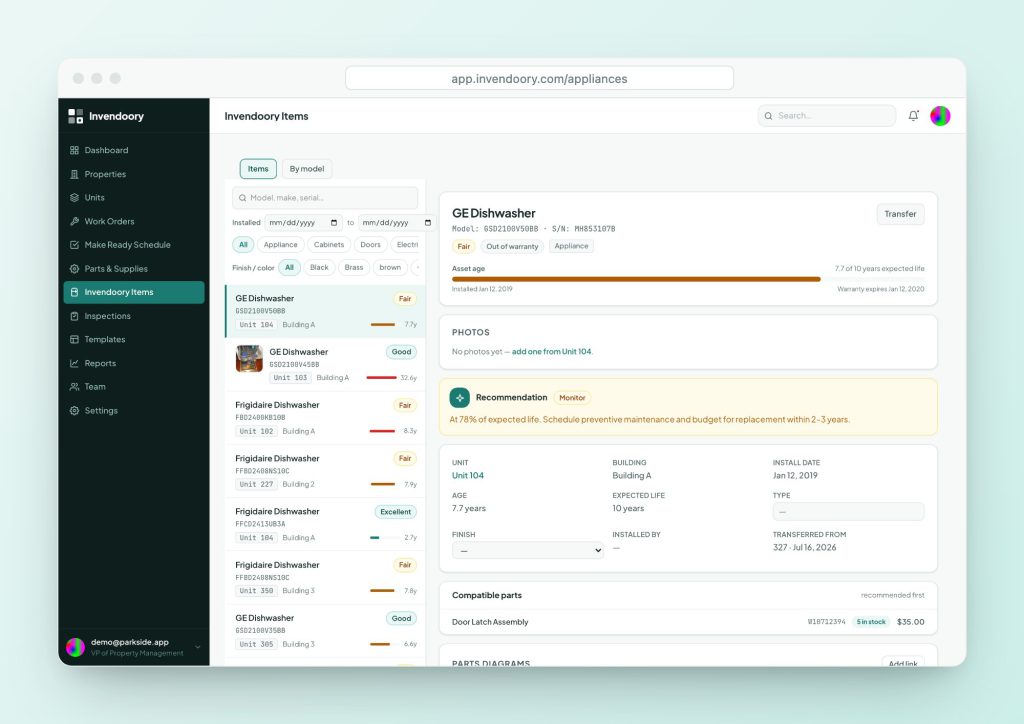
Appliance life expectancy is a range, not a date. This guide puts the published numbers for every common apartment appliance and finish in one chart, shows where the sources disagree, and explains how to plan replacements across hundreds of units.
How long do appliances last?
Most kitchen and laundry appliances last 9 to 15 years in a home. Water heaters and HVAC equipment run from about 10 to 20 years, and flooring and paint depend on the material and the traffic. These are averages across many households, and no source treats them as a promise.
The life expectancy of appliances in an apartment is usually shorter than in a single-family home. Units turn over, residents use equipment differently, and a failed unit is a work order the same day. Fannie Mae’s multifamily tables, which were written for apartment underwriting, show lower numbers for some items than the homeowner studies do. The chart below lists each source side by side so you can see the spread.
Appliance life expectancy chart: years by item and source
Years of expected life. “Invendoory default” is the expected life the app starts each item with, and you can change it per item. Where a source gives a range, the range is shown.
| Item | Invendoory default | Published ranges | Sources |
|---|---|---|---|
| Refrigerator | 15 | 13 standard, 9 compact (NAHB); 9 to 13 (InterNACHI); 10 (Fannie Mae multifamily) | NAHB, InterNACHI, Fannie Mae |
| Range (stove and oven) | 15 | 13 electric, 15 gas (NAHB); 13 to 15 electric, 15 to 17 gas range (InterNACHI); 15 (Fannie Mae) | NAHB, InterNACHI, Fannie Mae |
| Microwave | 10 | 9 (NAHB); 9 (InterNACHI); 10 (Fannie Mae) | NAHB, InterNACHI, Fannie Mae |
| Range hood | Not set | 14 (NAHB); 14 (InterNACHI); 10 (Fannie Mae) | NAHB, InterNACHI, Fannie Mae |
| Dishwasher | 12 | 9 (NAHB); 9 (InterNACHI); 5 to 10 (Fannie Mae) | NAHB, InterNACHI, Fannie Mae |
| Garbage disposal | Not set | 12 (NAHB); 12 (InterNACHI) | NAHB, InterNACHI |
| Washer | 12 | 10 (NAHB); 5 to 15 (InterNACHI) | NAHB, InterNACHI |
| Dryer | 13 | 13 (NAHB); 13 (InterNACHI) | NAHB, InterNACHI |
| Water heater, tank | 12 | 10 gas, 11 electric (NAHB); 6 to 12 (InterNACHI); 10 (Fannie Mae, unit level); 10 to 15 (DOE) | NAHB, InterNACHI, Fannie Mae, DOE |
| Water heater, tankless | Not set | 20 or more (NAHB); 10 (InterNACHI); more than 20 (DOE) | NAHB, InterNACHI, DOE |
| Furnace | 15 (HVAC) | 15 to 20 (NAHB); 15 to 25 (InterNACHI); 20 (Fannie Mae) | NAHB, InterNACHI, Fannie Mae |
| Central AC and heat pump | 15 (HVAC) | AC 10 to 15, heat pump 16 (NAHB); AC 7 to 15, heat pump 10 to 15 (InterNACHI); heat pump condenser 15 (Fannie Mae) | NAHB, InterNACHI, Fannie Mae |
| Carpet | 10 (flooring) | 8 to 10 (NAHB); 8 to 10 (InterNACHI); 7 (Fannie Mae) | NAHB, InterNACHI, Fannie Mae |
| Vinyl and resilient flooring | 10 (flooring) | up to 50 (NAHB); 25 (InterNACHI); 10 (Fannie Mae) | NAHB, InterNACHI, Fannie Mae |
| Laminate flooring | 10 (flooring) | 15 to 25 (NAHB); 15 to 25 (InterNACHI) | NAHB, InterNACHI |
| Interior paint | 7 | 15 or more (NAHB); 10 to 15 (InterNACHI) | NAHB, InterNACHI |
| Kitchen cabinets | Not set | 20 wood, 15 particle board (Fannie Mae) | Fannie Mae |
| Bathroom exhaust fan | Not set | 10 (NAHB); 10 (Fannie Mae) | NAHB, Fannie Mae |
NAHB figures come from the 2007 NAHB and Bank of America study, which bases its appliance numbers on first-owner use. Every row is a planning range, not a guarantee.
Oven life expectancy, stove life expectancy and microwave life expectancy
Oven life expectancy and stove life expectancy are the same question in an apartment, because the range is one appliance. The sources put gas ranges at 15 to 17 years (InterNACHI) and electric ranges at 13 to 15, with NAHB at 15 and 13. Fannie Mae uses 15 for a multifamily range.
Microwave life expectancy is shorter: 9 years in NAHB and InterNACHI, 10 in Fannie Mae. Because a microwave costs little next to a mid-lease work order, many teams replace one on the turn when it is near the end of its range.
Dishwashers show the widest spread. NAHB and InterNACHI say 9 years, while Fannie Mae’s multifamily table says 5 to 10. When three credible sources disagree by a factor of two, plan with the low end and let condition decide whether a unit actually goes.
Life expectancy guides by appliance
Each guide below covers one category in detail, with the sources for its numbers.
Water heaters
Tank, tankless and heat pump lifespans, strapping and how to read the date code.
HVAC
Furnaces, central AC and heat pumps, and what moves the number in a portfolio.
Refrigerators
Standard and compact refrigerators, plus how to look up the age and run a recall check.
Garbage disposals
How long disposals last and how to find the age on a label.
Garbage disposal life expectancy
Washers and dryers
Washer and dryer lifespans, hose and vent upkeep, and fire risk.
Washer and dryer life expectancy
Carpet
Carpet life expectancy and how depreciation drives a fair move-out charge.
How old is it? Decode the serial number
Life expectancy only helps when you know the age. Pick a brand, enter the serial from the rating plate and get the build date. See all brands on the appliance age finder.
Track appliance life expectancy on every unit
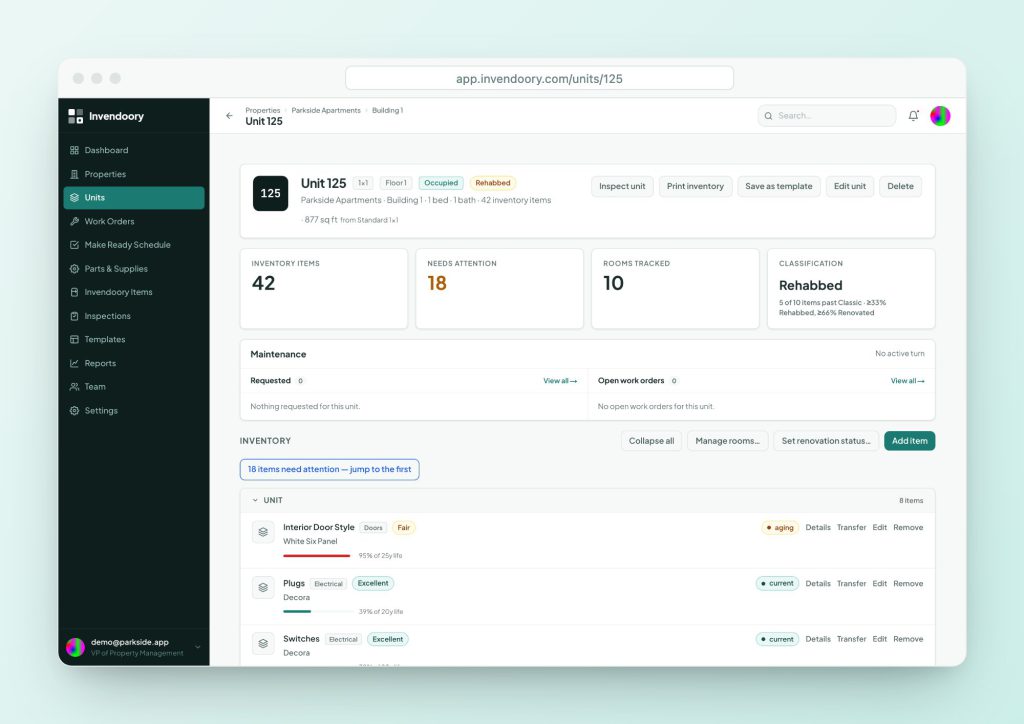
A chart tells you the average. Your portfolio is a spread of installs from different years, with different brands in different buildings. Invendoory records the install date and an expected life on each item, then shows a life used bar: green under 60%, amber from 60 to 80% and red above 80%.
The units table can show a column per category with the installed item and its years of life left. The record also shows a warranty badge and Repair, Monitor or Replace guidance. That guidance comes from fixed age and condition rules, not a prediction.
- Life used bar: green under 60%, amber 60 to 80%, red above 80%
- Years left per category in the units table
- Warranty badge on every item
- Repair, Monitor or Replace from fixed age and condition rules
Turn the chart into a replacement budget
Start by deciding which number you trust for each category, then set it as the expected life. A refrigerator set to 15 years turns red after year 12, which gives you about three years of warning. Warranty dates matter too, because a failure inside the warranty window should not become a capital line.
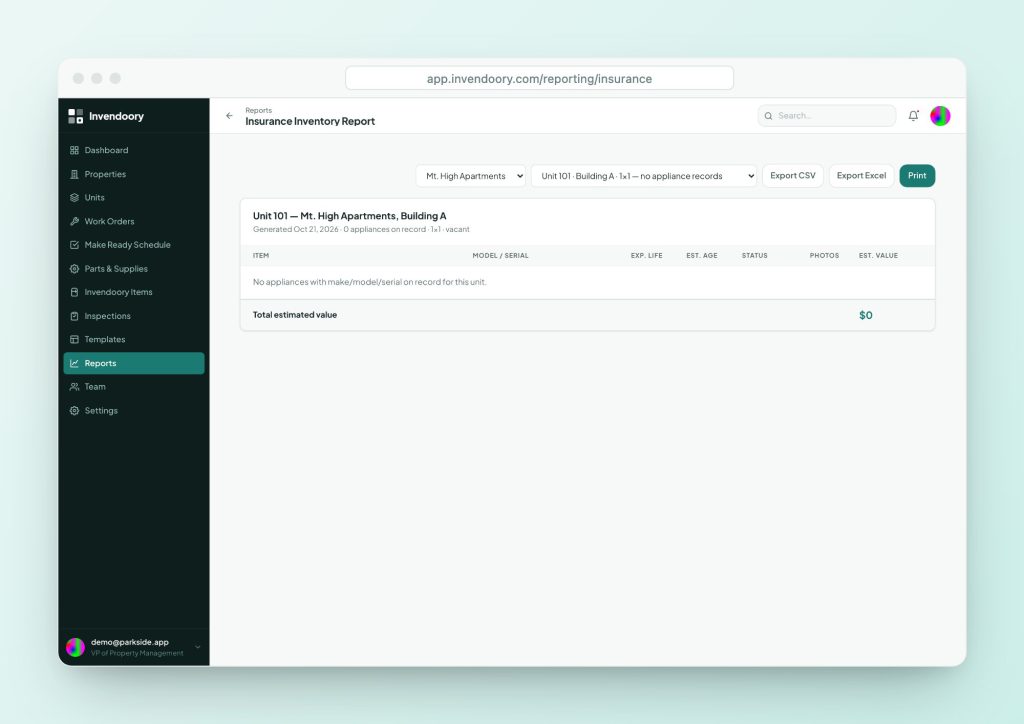
The Insurance Inventory report lists every item with its age, expected life and estimated depreciated value, so the same data supports a reserve conversation and an insurance schedule. The Budget Projection report then compares spend against budget by category.
- Pick one expected life per category and adjust per item
- Use years left to group replacements by property
- Export any report to CSV or Excel for the budget file
Find every unit with a recalled model
When a manufacturer recalls a model, the question is which of your units have it. Invendoory’s By model view lists every unit that has a given make and model, so you can answer in minutes instead of walking the property. Check the U.S. Consumer Product Safety Commission recall list for the model, then use By model to find the units.
For a deeper walk-through, see the appliance recall lookup guide. To log the installed base in the first place, the asset inventory page shows what a full record looks like.
Appliance life expectancy questions
What is the average appliance life expectancy?
Most household appliances land between 9 and 15 years. Dishwashers and microwaves sit near 9 to 10, refrigerators and dryers near 13, and gas ranges near 15. Water heaters and HVAC equipment run from about 10 to 20 years. Treat these as planning ranges and let condition decide each replacement.
Why do the sources disagree?
They sample different households and equipment. NAHB bases its appliance numbers on first-owner use, InterNACHI publishes ranges, and Fannie Mae writes averages for multifamily underwriting. Where they differ, this chart shows each number so you can pick the one that matches your buildings.
Do apartment appliances wear out faster than home appliances?
Sometimes. Several multifamily figures are lower than the homeowner studies, such as dishwashers at 5 to 10 years and refrigerators at 10. The sources do not say why, so use your own replacement history to adjust the defaults.
What expected life does Invendoory use?
Each item starts with a default: refrigerator 15, range 15, HVAC 15, dryer 13, dishwasher 12, washer 12, water heater 12, microwave 10, flooring 10 and paint 7 years. You can change the expected life on any item. The life used bar and years left follow from that number.
Does Invendoory tell me when to replace something?
It shows life used, years left and Repair, Monitor or Replace guidance. The guidance comes from fixed age and condition rules, not artificial intelligence, and a person decides what to do. It is meant to shortlist units for inspection, not to replace judgment.
Sources
- NAHB and Bank of America Home Equity, Study of Life Expectancy of Home Components (2007) (Appliance figures based on first-owner use.)
- InterNACHI, Estimated Life Expectancy chart
- Fannie Mae, Multifamily Property Condition Assessment, Appendix F Estimated Useful Life Tables (Form 4099.F, 10/14) (Multifamily column.)
- U.S. Department of Energy, Energy Saver Guide (2022) (Water heater lifespans.)
- U.S. Consumer Product Safety Commission, Recalls
Checked October 2026.