HVAC lifespan is 10 to 15 years for many air conditioners and 15 to 25 for furnaces, depending on who you ask. This guide lays out the HVAC life expectancy ranges by equipment type and how to plan replacements across a portfolio.
HVAC life expectancy by equipment type
HVAC life expectancy depends on who you ask: three sources, three answers. Where they differ, plan with the lower number and let condition decide.
| Equipment | NAHB (2007) | InterNACHI | Fannie Mae multifamily |
|---|---|---|---|
| Furnace | 15 to 20 (gas 18, electric 15, oil 20) | 15 to 25 | 20 (gas or electric with AC); 25 for unit-level hot air furnace |
| Central air conditioner | 10 to 15 (unitary 15, room 10) | 7 to 15 | Not listed separately |
| Heat pump | 16 | 10 to 15 | 15 (condensing component, unit level) |
| Packaged terminal AC (PTAC) | Not listed | Not listed | 15 |
| Window or through-wall AC | 10 (room AC) | Not listed | 10 |
| Rooftop packaged unit | Not listed | Not listed | 15 (unit level) |
The U.S. Department of Energy uses an average residential air-source heat pump life of 15 years in its lifetime cost calculations, and Lennox says central air conditioners typically last 15 to 20 years.
How long does an AC unit last?
How long an AC unit lasts depends on the type. A window or through-wall unit is about 10 years in both NAHB and Fannie Mae. A central air conditioner sits at 10 to 15 years in NAHB, 7 to 15 in InterNACHI and 15 to 20 in Lennox’s own guidance. The gap is wide because the studies average very different equipment and climates.
The U.S. Department of Energy takes a replacement view. Its Energy Saver guide says to consider replacing a heat pump or air conditioner that is more than 10 years old, and a furnace or boiler that is more than 15 years old, especially if it needs frequent repairs and bills are rising. That is a prompt to evaluate, not a failure date.
For HVAC lifespan across a portfolio, the useful reading is this: an AC past 10 years deserves a look, and one past 15 is beyond most published averages.
Useful life of HVAC versus service life
The useful life of HVAC equipment is the figure used in reserve studies and property condition assessments. It is an average used for planning how much to set aside, not a promise that a given unit will fail on that day. Fannie Mae states that its Estimated Useful Life tables are standardized averages that do not replace the assessor’s judgment of an individual property.
Service life is what a particular unit actually delivers, and it depends on maintenance, climate and use. Lennox lists lack of regular maintenance, hot and humid climates, thermostat settings that make the system run more, poor sizing and poor installation as the factors that shorten life.
In practice, HVAC lifespan has two uses, and HVAC life expectancy tables feed the first. You use useful life to build the budget, and service life, meaning condition and repair history, to decide which units move up or down the list. For more on this, see property condition assessments and the reserve study guide.
How old is the HVAC unit? Decode the serial
Pick a brand and enter the serial from the data plate. The HVAC serial number lookup covers Carrier, Trane, Goodman, Heil and more.
Furnace life expectancy
Furnace life expectancy has a long tail. NAHB says furnaces average 15 to 20 years, with gas at 18, electric at 15 and oil at 20. InterNACHI gives 15 to 25. Fannie Mae uses 20 for a furnace paired with AC in standard multifamily, and 25 for a unit-level hot air furnace.
The DOE prompt to consider replacement at 15 years is lower than any of those upper numbers. On these published numbers a furnace outlasts the air conditioner paired with it, so plan the two separately.
Track HVAC lifespan on every unit
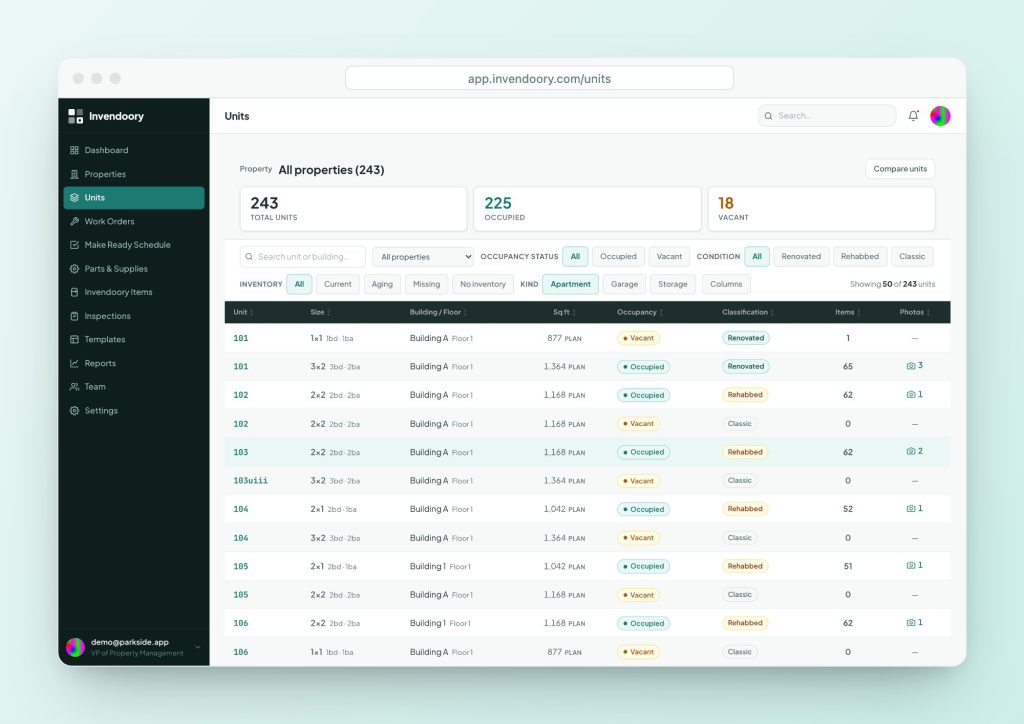
A unit-level HVAC system is an item in Invendoory, with make, model, serial, install date, warranty expiry and expected life. HVAC defaults to 15 years. At 15 years, the life used bar turns amber at 9 years and red past 12.
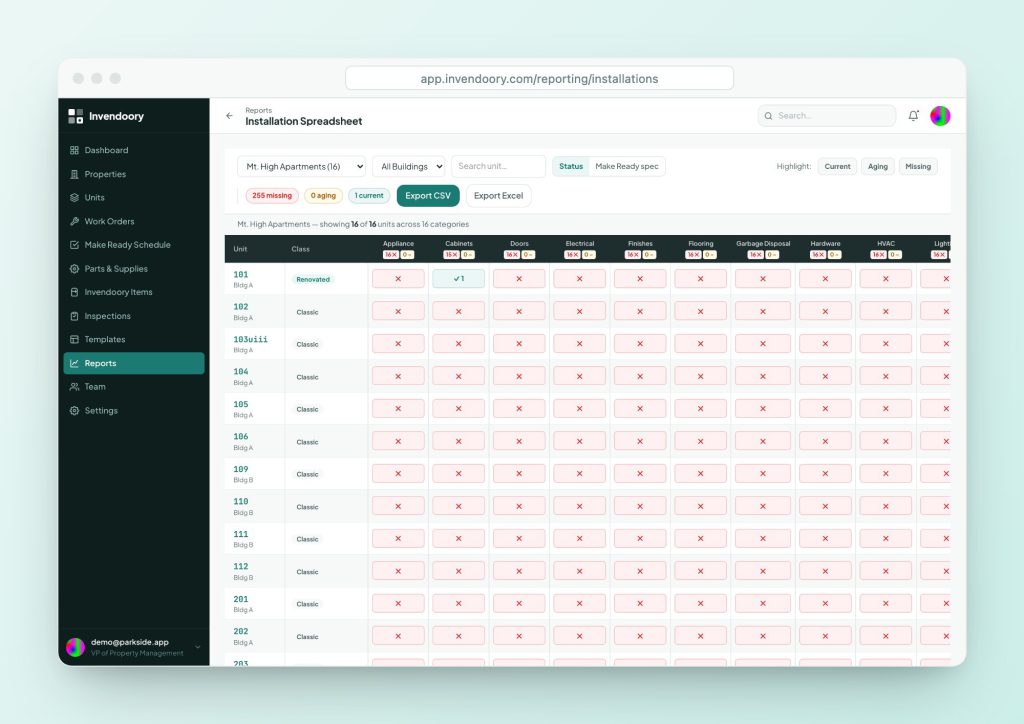
The units table lets you add a column per category, so you can read the installed HVAC item and its years of life left across a property. The Installation Spreadsheet report shows a color-coded grid of units by asset category, which makes a cluster of aging equipment in one building easy to see.
- Default expected life of 15 years, editable per item
- Per-category column with years of life left
- Installation Spreadsheet grid by unit and category
- Warranty badge and heads-up 30 days before expiry
Tie HVAC repairs to the equipment
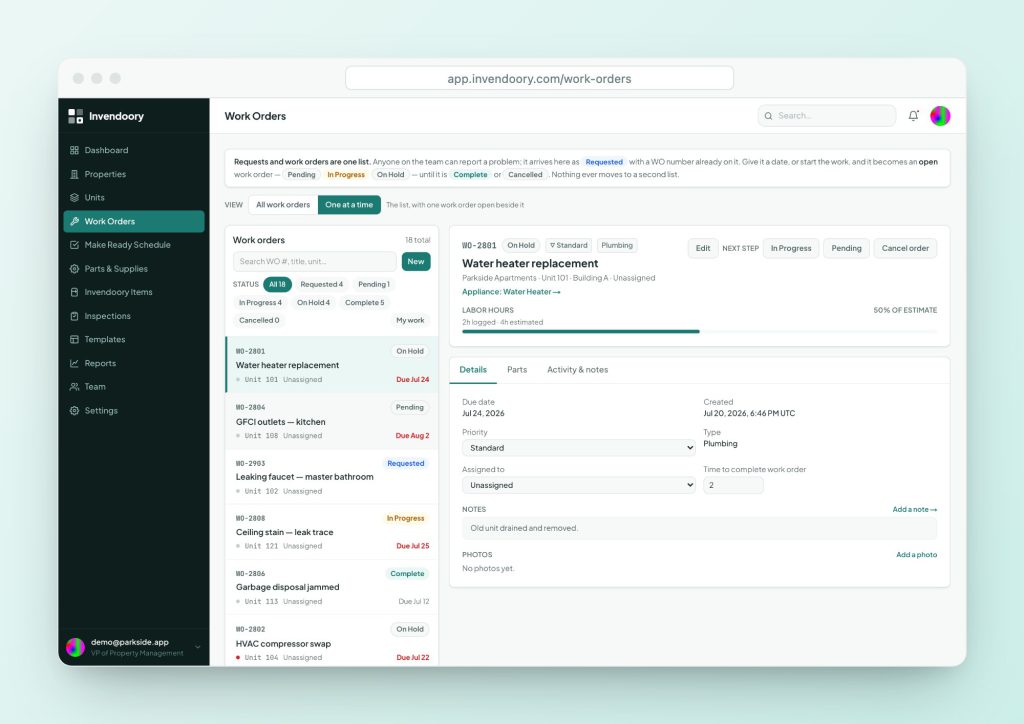
Work orders have an HVAC type and link to the unit and the specific appliance. That means the repair history sits on the unit’s record. A third call in one summer is a data point you can weigh against the DOE prompt about frequent repairs and rising bills.
When a replacement work order is completed, the appliance record updates with the new make, model, serial, value and warranty. Then life used resets from the new install, and the next budget cycle starts from the right place. See work orders for how requests and work orders share one lifecycle.
- Work order type: HVAC, linked to the unit and appliance
- Repair history stays on the record
- Completing a replacement updates make, model, serial, value and warranty
Budget replacements and check recalls by model
Use years left to group replacements by property and season, since HVAC lifespan varies by building and equipment type, then compare actual spend with budget in the Budget Projection report. Start from the appliance life expectancy chart if you need numbers for the other categories.
If a model is recalled, the By model view lists every unit that has that make and model, so you know which units to visit. Check the manufacturer and the U.S. Consumer Product Safety Commission first, then use By model to find the units.
HVAC lifespan questions
How long does an AC unit last?
Window or through-wall units are about 10 years. Central air conditioners are 10 to 15 years in NAHB, 7 to 15 in InterNACHI and 15 to 20 in Lennox’s guidance. The Department of Energy suggests considering replacement past 10 years, especially with frequent repairs.
What is the useful life of HVAC equipment?
Useful life is the planning average used in reserve studies. Fannie Mae uses 15 to 20 years for most multifamily HVAC equipment and 25 for a unit-level hot air furnace. It is a budgeting number, and the condition of each unit still decides when it goes.
What is a typical furnace life expectancy?
NAHB says 15 to 20 years, with gas at 18. InterNACHI says 15 to 25, and Fannie Mae uses 20 for most multifamily furnaces. The Department of Energy suggests considering replacement past 15 years.
How do I find the age of an HVAC unit?
Read the serial number on the data plate and decode it by brand. The HVAC age finder on this site does that for several brands. The result is the build date, so add the install date from your records if you have it.
Does Invendoory track furnaces and ACs separately?
Each piece of equipment can be its own item with its own install date, warranty and expected life, so a furnace and a condenser installed together can age on different clocks. The default expected life for HVAC is 15 years and you can change it.
Sources
- NAHB and Bank of America Home Equity, Study of Life Expectancy of Home Components (2007)
- InterNACHI, Estimated Life Expectancy chart
- Fannie Mae, Multifamily Property Condition Assessment, Appendix F Estimated Useful Life Tables (Form 4099.F, 10/14)
- U.S. Department of Energy, Energy Saver Guide (2022) (Replacement prompts: heat pump or AC over 10 years, furnace or boiler over 15.)
- U.S. Department of Energy FEMP, Purchasing Energy-Efficient Residential Air-Source Heat Pumps (15-year average heat pump life used in cost calculations.)
- Lennox, How Long Do Air Conditioners Last?
Checked October 2026.