
A property condition assessment gives a buyer or lender an independent read on the physical state of an apartment community. Here is what it covers, what it leaves out, and how a unit-level record makes it faster.
What a property condition assessment is
A property condition assessment, or PCA, is an outside consultant’s review of a property’s physical condition. The consultant walks the site, reads the records and interviews the people who run it. The result is a property condition report that lists material physical deficiencies and what it would cost to fix them.
In the United States, the common reference is ASTM E2018, the Standard Guide for Property Condition Assessments: Baseline Property Condition Assessment Process. The current edition is E2018-24. The guide is voluntary, so a lender or buyer can ask for more or less than it describes.
The stated goal is to identify and communicate material physical deficiencies to the person who commissioned the work. That word “material” matters. A PCA is not a punch list of every scuffed wall.
What the baseline process covers
ASTM E2018 describes a walk-through survey plus research. The consultant looks at the primary improvements: the site, structure, roofs, exterior, plumbing, electrical, HVAC and common areas. For multifamily, the guide gives observation guidance specific to apartment buildings.
A current walk-through, interviews and a review of building and fire department records are the minimum for a report to be consistent with the guide. Prior reports can help planning, but the consultant has to verify them.
- Walk-through survey of the site and buildings
- Document review and interviews with staff
- Cost opinions for each suggested remedy
A PCA versus a unit-level inventory
The two documents answer different questions. You usually need both during multifamily due diligence.
| Property condition assessment | Unit-level inventory | |
|---|---|---|
| Who makes it | An outside consultant, once per transaction | Your own team, kept current |
| Focus | Material deficiencies in the primary improvements | Every installed item, room by room |
| Unit detail | Representative sample of units | Every unit you have recorded |
| Output | Property condition report with cost opinions | Make, model, serial, install date, warranty, photos |
| Shelf life | A snapshot on the day of the walk-through | Changes whenever an item is replaced |
ASTM E2018 allows a consultant to extrapolate observations from sampled units to similar areas and systems. That is why a good record of the units they do not open matters.
How acquisitions and refinancing use the report
A buyer uses the property condition report to price the deal. Deferred maintenance becomes a credit or a reserve, and short-lived systems become a capital plan. The same component and life data also feeds a reserve study. The report sits beside the appraisal, the rent roll and the environmental review in multifamily due diligence.
A lender uses it to decide how much to hold back for immediate repairs and replacement reserves. Agencies and lenders publish their own PCA instructions, such as Fannie Mae’s Form 4099 for multifamily, and those can add requirements on top of the ASTM guide. Read your lender’s version before you hire anyone.
A condition report also helps an owner who is not selling. It shows what the next five years of capital spending look like before the budget meeting.
What to have ready before the consultant arrives
The faster you answer the consultant’s questions, the less they have to estimate.
1. Unit access
Confirm which vacant and occupied units the consultant will open, and give residents notice under your lease and local rules.
2. Age and history
Gather install dates for roofs, boilers, water heaters, HVAC and appliances, plus recent replacements and warranties.
3. Open issues
List open work orders, recurring complaints and any known areas of concern, so nothing surprises the consultant.
4. Records
Pull permits, fire inspection reports, prior condition reports and capital spending for the last several years.
An item-level record speeds multifamily due diligence
Most of a consultant’s questions are about age and condition. How old is that water heater? Has this unit been renovated? Which appliances are still under warranty? If the answers live in six spreadsheets and a maintenance supervisor’s memory, someone has to dig.
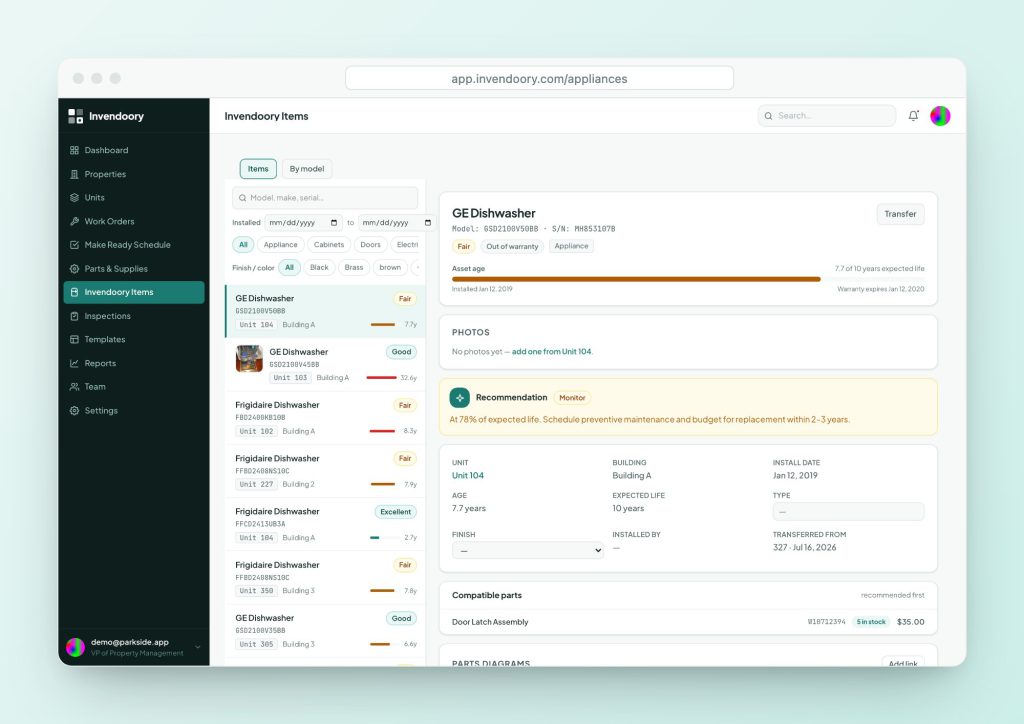
In Invendoory, every unit lists its items room by room with make, model, serial, install date, warranty and up to 20 tagged photos. Each item has a life-used bar, so you can see the oldest items first. A unit page can be printed, filtered by category.
- Install date, warranty and expected life on every item
- Photos tagged as serial plate, condition or damage
- Each unit classified Classic, Rehabbed or Renovated
Give the buyer or lender a report, not a login
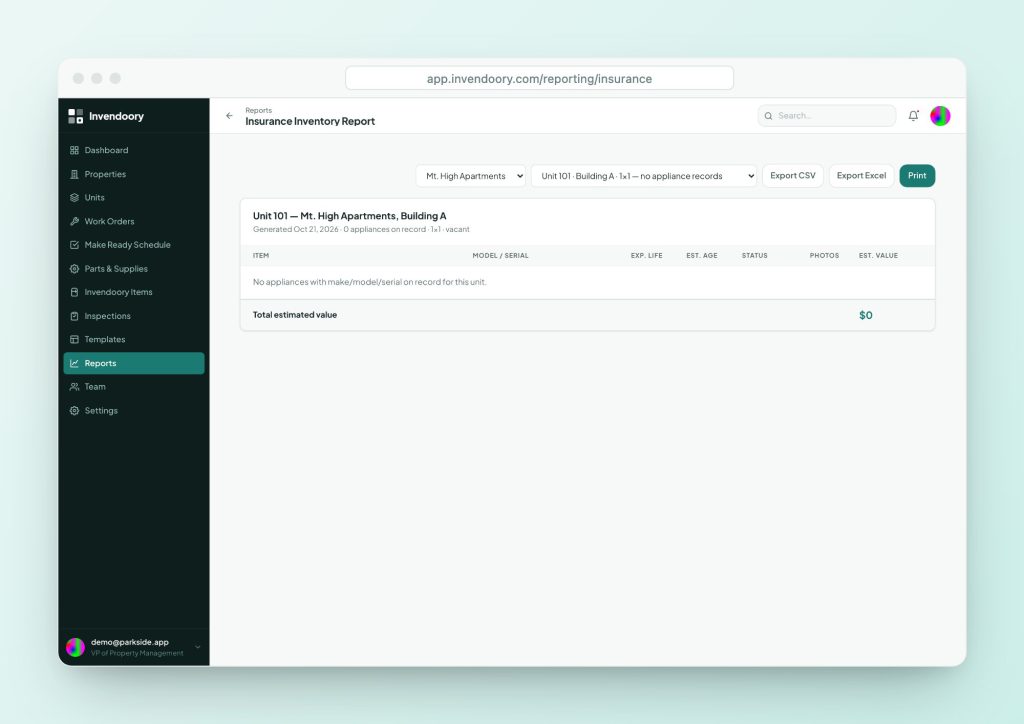
The Insurance Inventory Report lists, per unit, every item with model and serial, age, expected life, status, photos and an estimated depreciated value. Reports export to CSV and Excel, so you can send the same rows to a consultant or an underwriter. For the insurance side, see what a statement of values asks for.
Invendoory does not replace the consultant’s walk-through, and it does not write a property condition report. It gives you the clean data a consultant would otherwise reconstruct. Read more in the Insurance Inventory Report guide.
- Per-unit item list with depreciated value
- CSV and Excel exports
- Printable unit inventories
Keep the record current so the next PCA is easier
A record that was accurate on closing day drifts within a year. In Invendoory, when a manager verifies a turn or someone completes a work order for a replaced appliance, the unit’s inventory updates itself with today’s date. See asset inventory for how that works.
That means the next property condition assessment, refinance or insurance renewal starts from a record someone has been maintaining, not one you have to rebuild.
Property condition assessment questions
Who orders a property condition assessment?
Usually the buyer or the lender, and sometimes an owner planning capital work. The party that orders it is called the user in ASTM E2018. Because the guide is voluntary, the engagement letter or your lender’s instructions decide the real scope.
How is a property condition report different from a home inspection?
A PCA covers a commercial or multifamily property, uses a defined process and prices remedies. A home inspection looks at one dwelling for a buyer’s decision. A property condition report also looks at site, structure and common areas, and it relies on a sample of units.
Does the consultant inspect every apartment?
Usually not. ASTM E2018 allows observations in representative units to be extrapolated to similar areas and systems. Your own records of the units they skip fill that gap and can shorten the questions they send you.
How long does a PCA take?
It depends on property size, access and the lender’s requirements, so there is no single number. Ask the consultant for a schedule in writing. Having ages, warranties and open work orders ready avoids most of the waiting.
Can Invendoory replace a PCA?
No. A PCA is an independent assessment by a qualified consultant, and your lender decides whether one is required. Invendoory is the inventory behind your answers, with ages, photos and history for the items in each unit.
Sources
- ASTM E2018-24, Standard Guide for Property Condition Assessments: Baseline Property Condition Assessment Process (Purpose, walk-through, document review, interviews, cost opinions and edition history.)
- Fannie Mae Multifamily forms, including Form 4099 PCA instructions (Example of a lender’s PCA requirements layered on top of the ASTM guide.)
Checked October 2026.