Appliance age by serial number: free age finder
Pick a brand, type the serial number from the rating plate and get an estimated build date, the unit’s age and how much of a typical life is used. It covers water heaters, HVAC, appliances and disposers.
How old is my water heater, furnace or appliance?
Choose the brand, then paste the serial number exactly as printed, letters included. The line under the brand tells you where to find it.
Results are estimates of the manufacture date. The rating plate and the manufacturer’s support line are the authority.
How a serial number holds a date
Finding the appliance age by serial number works because most manufacturers stamp a date code into the first few characters. The code is short, so it trades detail for length. A year might be one letter, a month another letter, and everything after that is just a sequence number.
There is no common standard. Each brand picked its own layout and changed it over the decades. That is why the tool asks for the brand first. The same digits “0806” mean August 2006 on a Rheem and something else on a brand that puts the year first.
The date you get is when the unit was built. It was installed a few months later, and sometimes years later if it sat in a warehouse. If the plate prints a manufacture date, that beats the serial.
Six ways brands write the date
The tool matches your serial against the brand’s known layouts and picks out the date characters. These are the six styles it handles.
| Style | What it looks like | Brands in the tool |
|---|---|---|
| Letter year, letter month | DG6322957 | Bradford White (year letter repeats every 20 years); GE Appliances (every 12 years) |
| Year, then week | 1719106145074 | A. O. Smith, State, Whirlpool water heaters, Trane (2002 onward), Heil and the ICP family |
| Month, then year | RH 0806B17262 | Rheem and Ruud, GE water heaters |
| Year, then month | 0408 52398 | Goodman, Amana heating and cooling, InSinkErator |
| Week, then year | 4006A17330 | Carrier and Bryant |
| Year character, then week | FX2510000 | Whirlpool, Maytag, KitchenAid and Amana appliances (2010 to 2020) |
The examples are documented or constructed from documented formats. Each brand page explains its own code and lists its sources.
Pick your brand for the full decoder
Every brand page has its own tool preselected, a worked example and a list of what the tool cannot read. Or start with a category: water heaters or HVAC.
What the result tells you
A good result has five parts: the manufacture date, the unit’s approximate age, a typical life for that kind of equipment, an estimate of the life left and a bar showing the share of that life used. The bar is green under 60%, amber from 60% to 80% and red above 80%.
The typical life is the tool’s own planning default: 12 years for a water heater or appliance, 15 for HVAC and 10 for a garbage disposer. Published ranges are wider. If your sources say 10 years or 20, treat the bar as a prompt to look closer. Our appliance life expectancy guide compares the published numbers.
How old is my water heater when the serial has letters?
Water heaters are the most common reason people search for this. Letters in the first two positions usually mean a letter code. On a Bradford White, the first letter is the year and the second is the month, but the year letter repeats every 20 years. An A can be 1984, 2004 or 2024.
The tool shows the most recent possible year first and lists older candidates under it. If the unit looks far older than the first answer, read the “may be from” line, and compare it with the date on the rating plate. A. O. Smith, State and Rheem use digits that carry a year and a week or month, which are easier. See the full water heater age guide.
HVAC age by serial number
Furnaces, air handlers and outdoor units carry the serial on the rating plate. Most brands in the tool use digits for the date: Goodman and Amana put the year then the month first, Carrier and Bryant put the week then the year, and Trane puts the year then the week. The HVAC age guide shows each layout with an example.
Older HVAC units are the weak spot. Trane serials from before 2002, Carrier-family serials from before 1985 and Goodman units with letter codes are outside the rules we could verify, so the tool says it cannot date them rather than guess.
What the tool cannot read
The tool is honest about gaps. These serials come back as “can’t date”:
- Trane serials from before 2002, because the sources disagree on the old letter chart
- Whirlpool-built appliances from before 2010 or from 2021 onward
- Carrier-family serials from before 1985
- Rheem serials that use a week of 13 or higher in the month position
- InSinkErator’s 10-character format that started in summer 2024
- Newer GE-branded heat pump water heaters, which may use a different code
- Bradford White tankless and Aero-built oil-fired units
A serial dated in the future is also rejected. If yours falls in one of these groups, use the rating plate, the owner’s manual or the manufacturer’s support line.

From one serial number to a replacement plan
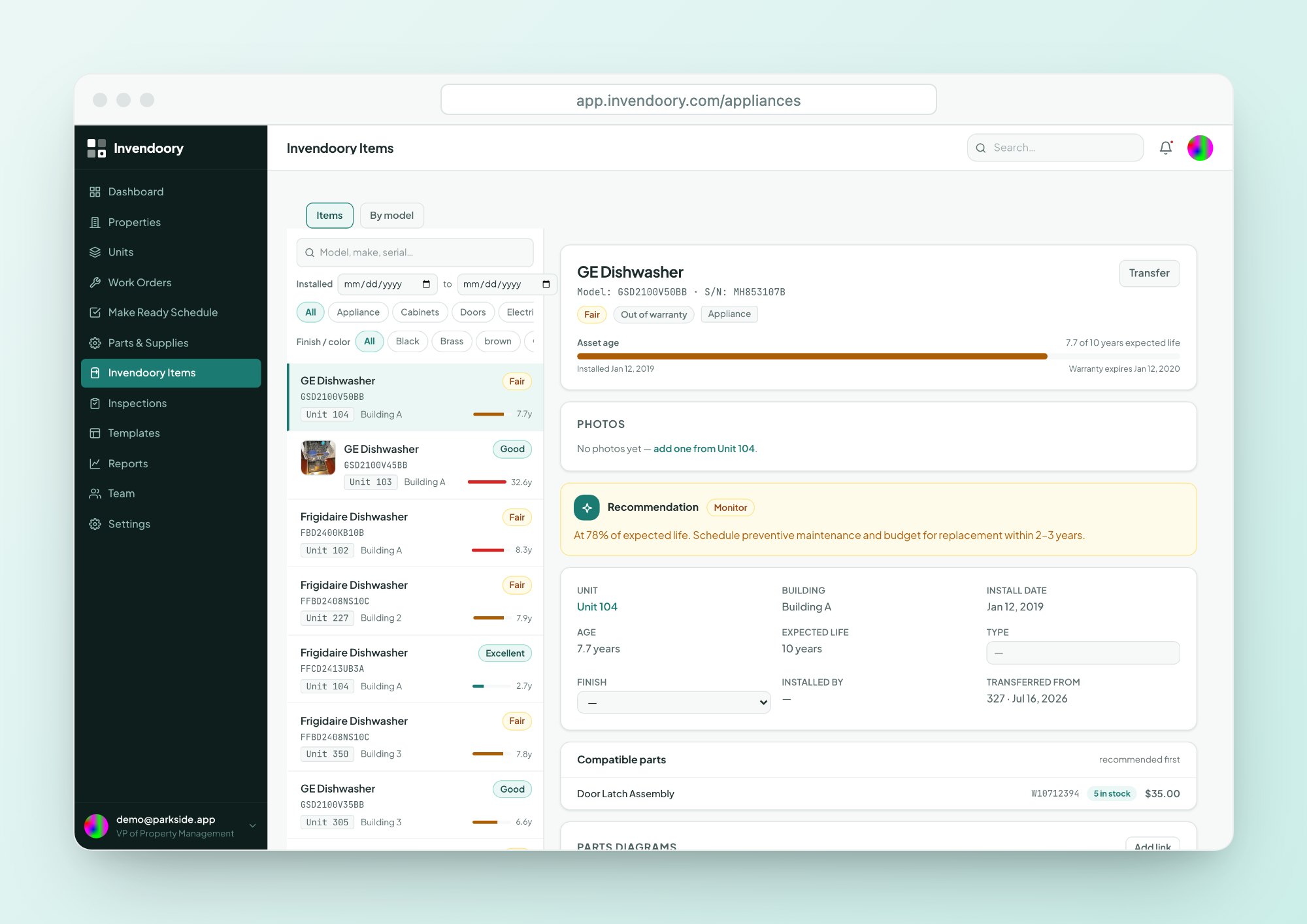
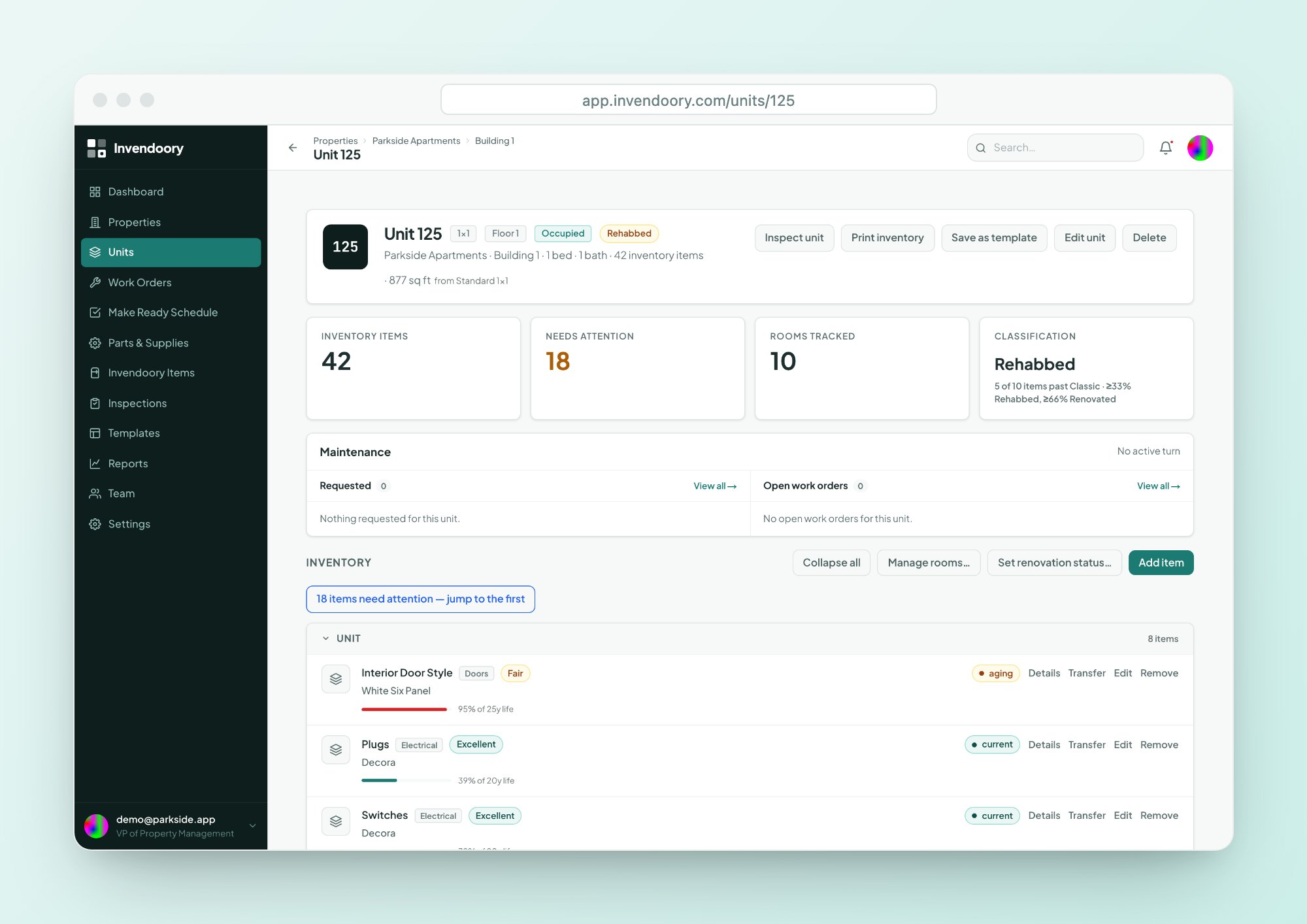
One answer helps one unit. The harder problem is 300 units where nobody wrote the date down. Invendoory stores make, model, serial, install date and expected life on each item, and lets you tag a photo of the serial plate to it. A life-used bar then shows which items are close to the end of their life.
That turns a clipboard exercise into a plan: which water heaters to replace this year, which furnaces to watch and what to budget. Read how the asset inventory keeps that record, or see how age feeds inspections.
Appliance age questions
Can you find an appliance's age by serial number?
Often, yes. Most brands put a date code in the serial, but the layout differs by brand and era. This tool reads 14 brand rules and returns an estimated manufacture date. When a serial is outside the rules, it says so instead of guessing.
Why does the tool show more than one year?
Some brands reuse letters. Bradford White repeats its year letter every 20 years and GE Appliances every 12. The tool shows the most recent year first and lists older ones. Use the rating plate date or the unit’s look to pick the right one.
How do I find HVAC age by serial number?
Find the rating plate on the furnace, air handler or outdoor unit, copy the serial and choose the brand. Goodman, Amana, Carrier, Trane and Heil are covered. The result shows an estimated build date and the share of a 15-year typical life used.
Is the manufacture date the install date?
No. The manufacture date is when the unit was built. The install date is usually a few months later and can be years later. Use the install date for warranty and depreciation if you have it, and the manufacture date when you do not.
What if my serial can't be dated?
Check that you copied the serial, not the model number, and included every letter. If it still fails, the format may be outside the rules. Look for a printed manufacture date on the plate, or contact the manufacturer’s support with the model and serial.
Sources
- Bradford White For The Pro – Determining the Age of a Water Heater
- Bradford White FAQ – How to read the serial number date code chart
- Building Intelligence Center – Bradford White water heater age
- InterNACHI Water Heater Dating Chart
- A. O. Smith Service and Warranty Guide, July 2024 (How to Read the Serial Number)
- Building Intelligence Center – A. O. Smith water heater age
- Building Intelligence Center – State water heater age
- Building Intelligence Center – Rheem water heater age
- InspectApedia – Rheem water heater age decoder
- Building Intelligence Center – GE water heater age
- InspectApedia – Hotpoint and GE water heater age
- Building Intelligence Center – Whirlpool water heater age
- InterNACHI forum – Whirlpool serial 0128104380
- PickHVAC – How old is my Goodman
- Building Intelligence Center – Goodman HVAC age
- PickHVAC – Amana HVAC age
- Building Intelligence Center – Amana HVAC age
- Building Intelligence Center – Carrier HVAC age
- PickHVAC – Carrier HVAC age
- PickHVAC – Bryant HVAC age
- PickHVAC – Trane HVAC age
- Building Intelligence Center – Trane HVAC age
- Parts Town – Trane serial number lookup
- Building Intelligence Center – Tempstar HVAC age (ICP family)
- InspectApedia – Tempstar and ICP HVAC age
- Building Intelligence Center – Heil HVAC age
- Appliance Parts Pros – GE serial number lookup
- ServiceMag – How to read your appliance model and serial number
- Appliance Parts Pros – Whirlpool serial number year lookup
- InSinkErator – Warranty and serial number
- NAHB and Bank of America Home Equity, Study of Life Expectancy of Home Components (2007)
- InterNACHI, Estimated Life Expectancy chart
- U.S. Department of Energy, Energy Saver Guide (2022)
Checked October 2026.
Know the age of every unit's equipment
The finder dates one serial at a time. Invendoory keeps the serial, install date and life used for every item in every unit. Open the live demo, no signup needed.