
Normal wear and tear is the aging a unit takes on from ordinary use. Damage is what goes beyond it. This guide shows where the line usually falls, item by item, and how records and proration keep your charges fair.
What is normal wear and tear? A working definition
So, what is normal wear and tear? In plain terms, it is the deterioration that comes from living in a unit the way it was meant to be lived in. Carpet flattens in the hallway. Paint dulls. A refrigerator door gasket stiffens after a decade.
Some states write this into statute. Texas, for example, defines normal wear and tear as deterioration that results from the intended use of a dwelling, and it excludes deterioration from negligence, carelessness, accident or abuse. Texas also says a landlord may not keep any part of a security deposit to cover normal wear and tear.
That is the core rule behind most security deposit deductions: you can charge for damage a resident is legally liable for, and you cannot charge for the unit simply getting older. States word it differently, so check yours. This guide is general information, not legal advice.
What is normal wear and tear, and what is damage? Item by item
These are typical examples, not a legal test. The same scuff can be wear in one unit and damage in another, depending on how long the resident lived there and what the lease and your state say.
| Item | Usually normal wear | Usually damage |
|---|---|---|
| Carpet | Matting and thinning in traffic lanes, general fading, light soiling that cleaning removes | Pet urine stains, burns, large rips, bleach spots, stains that cleaning cannot remove |
| Paint | Fading, scuffs, small nail holes from hanging pictures, dulling near light switches | Crayon or marker, smoke staining, large wall holes, unapproved colors |
| Appliances | A worn finish, an aged door gasket, a failure caused by the appliance reaching the end of its life | Cracked cooktop glass, dents from impact, broken shelves, a burned-out element from misuse |
| Blinds | Fading, yellowing, a slat that has weakened with age | Bent or broken slats, missing blinds, chew marks |
| Fixtures | A loose handle, a worn finish, mineral buildup, a leaking washer | A towel bar pulled out of the wall, a cracked toilet tank, burns on a vanity top |
| Hard flooring | Fine surface scratches, minor dulling in high-traffic spots | Deep gouges, water warping from a neglected spill, pet damage |
Examples are illustrative. Courts and statutes differ, and your lease may add detail. Confirm your approach with property counsel.
How depreciation makes a charge fair
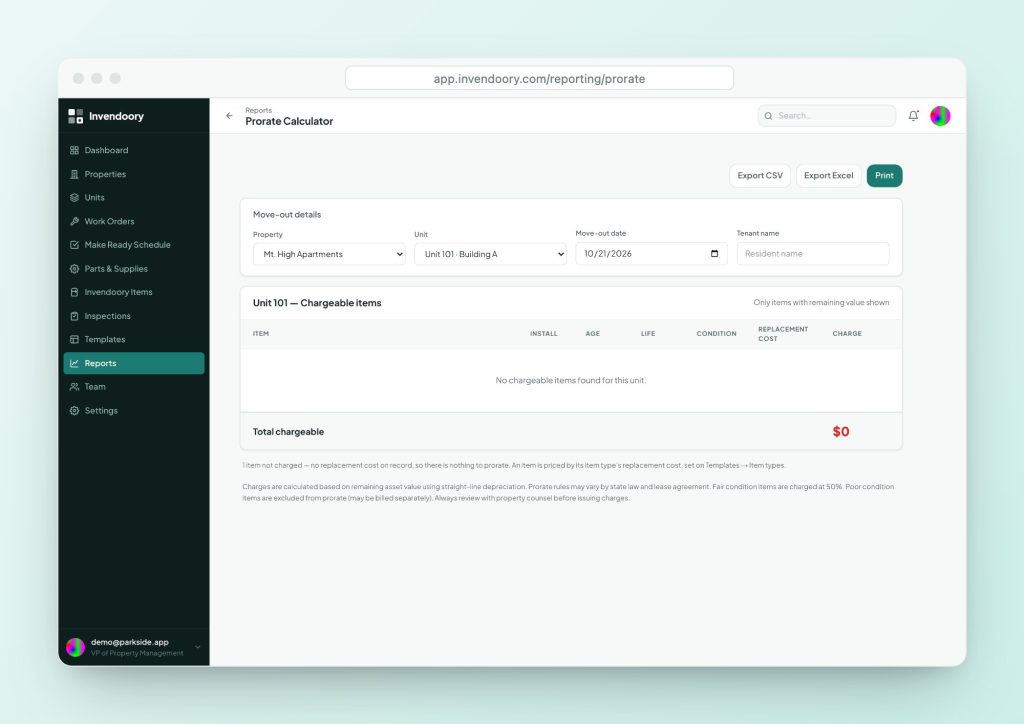
Even when damage is clear, the full replacement price is rarely the fair charge. A carpet that was already eight years old when it was stained had little life left to lose. Charging for a brand-new carpet gives the owner a windfall.
One California law-firm article gives the standard example: a carpet with a 10-year life is ruined at year 8, and replacement costs $1,000. The landlord can fairly charge $200, the two years of life that were left.
Invendoory’s Prorate Calculator applies the same idea with straight-line math: replacement cost x remaining life x condition factor, rounded to the nearest $50. Excellent and Good items count at 100%, Fair at 50%, and Poor items are left out of the total because they may involve damage, which is your call and your counsel’s.
- Remaining life = 1 minus age divided by expected life, never below 0
- Condition factor: Excellent and Good 100%, Fair 50%
- Poor items are excluded and reviewed separately
A prorated charge, step by step
Say a refrigerator costs $1,200 to replace, has an expected life of 13 years and is 4 years old, rated Good. Remaining life is 1 minus 4/13, or about 69%. That gives roughly $831, which rounds to $850. If the same refrigerator were rated Fair, the factor drops to 50% and the result rounds to $400.
The 13-year figure is a published industry average, and your own expected life may differ. These numbers are illustrations, not a quote for any unit. Proration only comes into play once you have decided something is damage, which makes “what is normal wear and tear” the first question. The point is that every input is something you can show a resident: price, age, life and condition.
Estimate a prorated move-out charge
Enter the item, its age and its condition to see how proration changes a charge. This is the free tool; the report in the app uses your own inventory.
Estimates only. Confirm charges against your lease and local law.
Records that separate damage from wear
A dispute is usually won or lost on paper. Settling what is normal wear and tear in writing beats arguing it at the door, and four records do most of the work.
1. Move-in condition
Record each room and item at move-in, with dated photos. Damage that was already there cannot fairly be charged later.
2. Install dates
Know when the carpet, paint and appliances went in. Age is what turns a full-price charge into a prorated one.
3. Move-out inspection
Walk the same rooms with the same list. Photograph anything you plan to charge for, with timestamps.
4. Itemized comparison
Set move-in against move-out, item by item, and show your math. See the move-in and move-out inspection checklist.
Keep install dates and photos on each item

A charge that holds up needs an install date, an expected life and a condition on the item itself. In Invendoory, each unit’s items are recorded room by room, with make, model, install date, expected life and up to 20 photos per item, tagged by type, including damage.
The life used bar shows age divided by expected life for every item, so you can see what a fair share looks like before a resident moves out. Inspection photos carry capture timestamps, which helps when a resident says the stain was always there.
When you do record a charge, Invendoory stores it as a chargeback during the inspection. Chargebacks are audited and locked after 30 days. Invendoory records the charge; it does not bill or collect it.
- Install date, expected life and condition on every item
- Up to 20 tagged photos per item
- Timestamped inspection photos
Rules vary by state, so confirm yours
Deposit law is local. In California, for instance, a landlord generally has 21 calendar days after move-out to refund the deposit or send an itemized statement of deductions, and missing that deadline can cost the right to keep any of it. Other states set different deadlines, interest rules and itemization requirements.
Some states answer “what is normal wear and tear” in statute, as Texas does. Others leave it to courts. Whether proration is required, expected or merely sensible also varies.
Treat any calculator, including ours, as a starting point for consistent and explainable numbers. Before you send charges to residents, review your process with property counsel. Nothing here is legal advice.
Normal wear and tear questions
Is faded paint normal wear and tear?
Generally yes. Paint fades and scuffs with ordinary use, and small nail holes from pictures are typically treated as wear. Crayon, smoke staining or large holes are more likely damage. How long the resident lived there matters, so check your state’s rules and your lease.
Can I charge a resident for a worn carpet?
Usually not for plain wear such as matting or thinning in traffic lanes. Stains or burns that cleaning cannot remove, or large rips, may be chargeable, and often only for the carpet’s remaining life. Confirm the approach with property counsel.
What if an appliance simply stopped working?
If it failed because it reached the end of its life, that is usually treated as wear, not resident damage. If the failure came from misuse or impact, it may be damage. Install dates and service history help show which it was.
Do I have to prorate a damage charge?
It depends on your state and lease. Many landlords and courts expect charges to reflect an item’s remaining useful life, and proration makes a charge easier to explain. Ask counsel whether your state requires it.
Does Invendoory decide what counts as damage?
No. The Prorate Calculator leaves Poor-rated items out of its total because they may involve damage, and that decision belongs to you, your lease and your counsel. It calculates consistent numbers from age, life and condition.
Sources
- Texas Property Code Sec. 92.001, definition of normal wear and tear (Public.Law)
- Texas Property Code Sec. 92.104, deductions from the security deposit (Public.Law)
- Stimmel Law, Security deposit refunds in residential leases: California basic law (Source for the 21-day rule and the $200 carpet proration example.)
- NAHB, Study of Life Expectancy of Home Components (2007) (Source for the 13-year standard refrigerator life used in the example.)
Checked October 2026.