Goodman serial number age: read the year and month
A Goodman serial is about ten digits, and the first four are the date: two for the year, two for the month. Enter yours below and read the estimate.
Check a Goodman serial number
Use the serial from the rating plate on a Goodman furnace, air handler or outdoor unit. The result is an estimate of the build month. The rating plate and Goodman are the authority.
Where to find the serial number on Goodman equipment
The serial number is on the rating plate on the side or back of the furnace, air handler or outdoor unit. A split system has a plate on each piece, so photograph both. The indoor and outdoor units can have different build dates, and a replaced coil or condenser is common.
Do not read the model number. The model number names the product. The serial is the mostly numeric string that holds the date.
If the plate prints a manufacture date, use it. If it does not, the serial is your best evidence short of calling the manufacturer.
Goodman serial number age: how the date is encoded
A Goodman serial is numeric and about 10 digits. The first two digits are the year. The next two are the month. The rest is a running number.
| Digits | Meaning | Example: 0408 52398 |
|---|---|---|
| 1 and 2 | Year | 04 = 2004 |
| 3 and 4 | Month | 08 = August |
| The rest | Running number | 52398 |
Documented examples: 0408 52398 is August 2004. 9704811080 is April 1997. A serial that begins 1609 is September 2016. A reader-submitted serial, 0211766862, is November 2002.
Reading 9704811080
Start with the first two digits: 97. The tool reads them as 1997, because 2097 is in the future. The next two digits are 04, which is April. The tool reports April 1997.
In October 2026 that furnace is about 29 and a half years old. Published furnace lifespans run 15 to 25 years, so it is beyond all of them, and it is the kind of unit to move to the top of a replacement list.
Now compare 0408 52398. The year digits are 04, so 2004, and the month digits are 08, so August. That unit is about 22 years old. Both serials are real examples from the references we used.
Note that the tool shows a month and a year here, not a week. Goodman’s layout, which Amana HVAC shares, uses a month. Carrier, Trane and Heil use a week.
What the Goodman rule can't tell you
The format is medium-high confidence. Two independent third-party references agree and show real data plates, but we found no document from Goodman itself. Treat the date as an estimate.
Pre-1990s Goodman units use letter codes that this tool does not read. Some PTAC units made for Goodman by Daikin also use letter codes, so we excluded them. If your serial has letters, expect “can’t date”.
A serial with an impossible month, such as 13 in digits 3 and 4, will not decode. Re-check that you copied the serial, not the model number, and that you didn’t drop a leading zero.
The date is when the unit was made. Installation is usually a few months later, and a coil or condenser swapped years afterward is a separate unit with its own plate.
Amana HVAC shares Goodman's date layout
Goodman builds more than its own name.
Amana heating and cooling
Amana-brand HVAC is built by Goodman and uses the same year-then-month layout. Before about 2001 the serial prints a dash after the year and gives only the year. Amana appliances are a different company with a different code.
Other HVAC brands
Carrier, Trane and Heil use week-based codes, not months. Do not decode them with the Goodman rule. Pick the brand on the unit’s plate.
How long Goodman furnaces and air conditioners last
No source gives a Goodman-specific lifespan. These are the published ranges by equipment type, and they disagree.
| Equipment | NAHB (2007) | InterNACHI | Fannie Mae multifamily |
|---|---|---|---|
| Furnace | 15 to 20 years | 15 to 25 | 20 (25 at unit level) |
| Central air conditioner | 10 to 15 | 7 to 15 | Not listed separately |
| Heat pump | 16 | 10 to 15 | 15 (condensing component) |
Lennox says central air conditioners typically last 15 to 20 years. The Department of Energy suggests considering replacement of a heat pump or air conditioner past 10 years and a furnace past 15. See HVAC lifespan.
Turning a Goodman date into a replacement plan
An HVAC system is a large item that you want to replace on your schedule, not on the hottest weekend of the summer. Equipment age is the first filter. A Goodman furnace made in 1997 belongs on the list. One made in 2018 does not, yet.
Record the serial, install date and a photo of the plate in the asset inventory. Each system carries an expected life and a life-used bar that goes from green to amber to red, so a supervisor can see which units in a building are close.
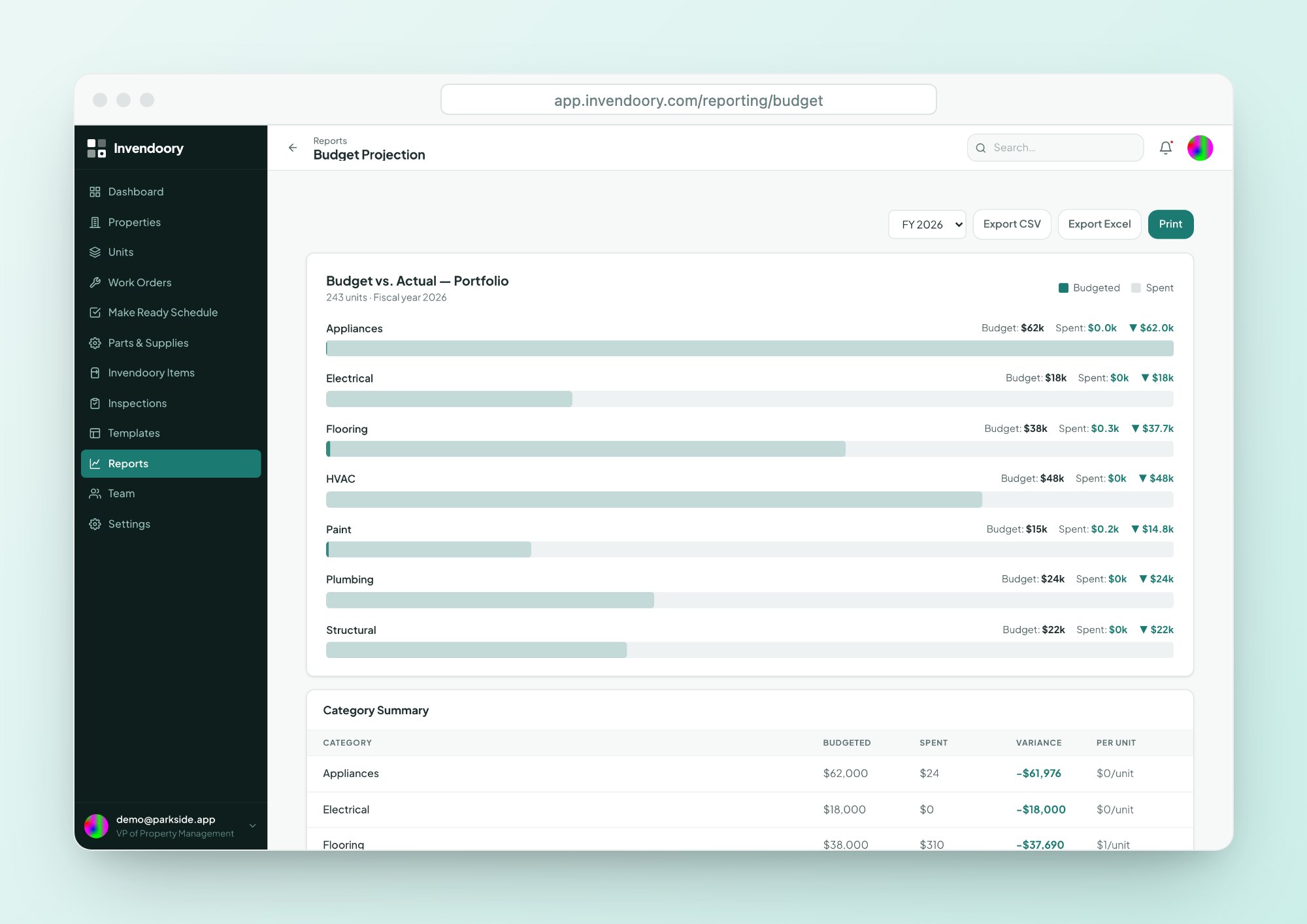
Then take it to the budget. The Budget Projection report compares budget with spend by category. Use the life left on your systems to decide what the HVAC category needs next year. At move-out, age feeds the Prorate Calculator for items a resident damaged.
- Photo of each rating plate stored with the item
- Life used shown by color on the unit page
- Budget compared with spend by category
Goodman serial number questions
How do I find Goodman serial number age for a furnace?
Find the serial on the rating plate. The first two digits are the year and the next two are the month. For example, 0408 52398 is August 2004. Enter it above for an estimate of the build month and the life left.
Why does my Goodman serial have letters?
For Goodman serial number age on a unit with letters, note that pre-1990s Goodman units and some PTAC units made for Goodman by Daikin use letter codes the tool doesn’t read. It will say it can’t date them. Look for a printed manufacture date on the plate instead.
Is the Goodman serial lookup accurate?
It is built from two third-party references that agree, not from a Goodman document. The date is an estimate of when the unit was made, and install is usually a few months later. Goodman and the plate are the authority.
Does this work for Amana furnaces?
Yes. Amana-brand heating and cooling is built by Goodman and uses the same year-then-month layout. Pick the Amana (HVAC) brand on the Amana page. Amana kitchen appliances use a different code.
How long does a Goodman furnace last?
No source gives a Goodman figure. For furnaces, NAHB says 15 to 20 years, InterNACHI 15 to 25 and Fannie Mae’s multifamily table 20. Plan with the lower end and let condition decide.
Sources
- PickHVAC, How old is my Goodman
- Building Intelligence Center, Goodman HVAC age
- NAHB and Bank of America Home Equity, Study of Life Expectancy of Home Components (2007) (Appliance figures are based on first-owner use.)
- InterNACHI, Estimated Life Expectancy chart
- Fannie Mae, Multifamily Property Condition Assessment, Appendix F Estimated Useful Life Tables (Form 4099.F, 10/14)
- Lennox, How Long Do Air Conditioners Last?
- U.S. Department of Energy, Energy Saver Guide (2022)
Checked October 2026.
Know which systems are close to done
Open the demo to see life used and years left on a unit’s items. No signup and sample data only.