Carpet life expectancy is 8 to 10 years in the homeowner studies and 7 years in Fannie Mae’s multifamily table. This guide shows the ranges, how carpet depreciation drives a fair move-out charge and how to track carpet age by unit.
How long does carpet last? What each source says
Carpet life expectancy is the finish with the most disagreement between a physical lifespan and a number on a tax form.
| Source | Carpet | Notes |
|---|---|---|
| NAHB and Bank of America (2007) | 8 to 10 years | With appropriate maintenance and normal traffic |
| InterNACHI | 8 to 10 years | Estimated life expectancy chart |
| Fannie Mae multifamily table | 7 years (10 for seniors housing, 3 or more for student housing) | Standardized average for dwelling unit floors |
| IRS Publication 527 | 5 years | Tax recovery period for carpeting in residential rental property, not a lifespan |
| Invendoory default, flooring | 10 years | Editable per item |
Resilient flooring (vinyl) is 10 years in Fannie Mae’s multifamily table, against 25 in InterNACHI and up to 50 in NAHB. Check which material a source means before you compare.
Why the useful life of carpet differs by source
The useful life of carpet in a rental tends to be shorter than in an owner-occupied home, and Fannie Mae’s number shows it. NAHB and InterNACHI say 8 to 10 years for ordinary use. Fannie Mae’s multifamily average is 7, falling to 3 or more for student housing, where wear is hardest.
The 5-year figure in IRS Publication 527 is different in kind. It is the recovery period for depreciating carpeting used in a residential rental activity on your taxes, and it does not describe how long the carpet lasts. Do not use it to size a resident charge, and ask your tax advisor how it applies to you.
For a move-out charge, the useful life is the number that matters, together with the carpet’s age and condition. You can document it with an install date, a make and model and photos. A defensible charge starts there.
Carpet depreciation and the move-out charge
Carpet depreciation is the idea behind a fair damage charge. A resident who ruins a 2-year-old carpet should be charged more than one who ruins a 9-year-old carpet, because the older carpet had little life left to lose.
Here is a straight-line illustration, not Invendoory’s formula or a legal rule. If a $1,000 carpet has a 10-year life and is 4 years old, 60% of its life remains, so the loss of value is about $600. At 9 years old, 10% remains, and the loss is about $100. The same stain, a very different charge.
Whether and how a landlord may charge for carpet damage varies by state. See normal wear and tear for how to separate wear from damage, and confirm your state’s rules. This is general information, not legal advice.
Estimate a prorated carpet charge
Try the carpet depreciation calculator with a carpet’s age, expected life and cost. It shows the arithmetic, so you can explain it to a resident.
Calculate carpet depreciation from the item record

The Prorate Calculator report works out a move-out charge per item from age, lifespan and condition. Because the carpet is an item in the unit with an install date and expected life, the inputs are already on file, and the figure matches the move-in record.
See the Prorate Calculator page for how the report works. The calculator on this site is the same idea in a lighter form.
- Charge per item from age, lifespan and condition
- Inputs come from the item’s install date and expected life
- Export the report to CSV or Excel
Track carpet age and replacement across units
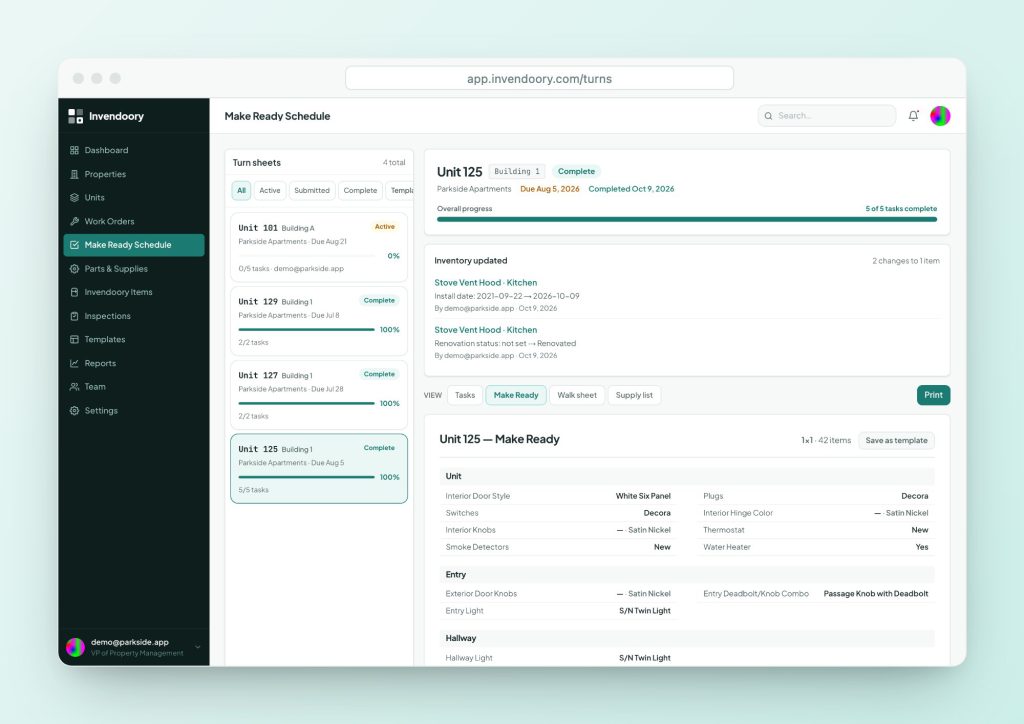
Set the expected life on carpet to the carpet life expectancy you trust, such as 7 or 10 years. Invendoory shows a life used bar for each carpet: green under 60%, amber from 60 to 80% and red above 80%. With a 10-year flooring default that is amber at 6 years and red past 8.
When a turn replaces the carpet, mark the item Replaced with the new product. After a manager verifies the turn, the unit’s inventory takes the new install with today’s date, so the age resets and the next move-out charge uses the right number. See Make Ready for the flow.
- Life used bar and years left on every carpet
- Replaced items become new installs when the turn is verified
- Photos with timestamps document condition at move-in and move-out
Budget carpet by years left
Carpet is a line on many turn budgets, and carpet life expectancy tells you when it comes due, and years left tells you which units are likely to need it. The units table can add a flooring column with the installed item and its years of life left. Group the reds by building and compare against the Budget Projection report.
For the full set of appliance and finish ranges, see the appliance life expectancy chart, and for the cost of leaving a unit empty while you replace flooring, read cost of vacancy.
Carpet life expectancy questions
How long does carpet last in a rental?
NAHB and InterNACHI say 8 to 10 years with normal traffic and maintenance. Fannie Mae’s multifamily table says 7, with 3 or more for student housing. Plan on 7 to 10 years, and shorten it for high-wear units.
What is the useful life of carpet for tax purposes?
IRS Publication 527 lists carpeting used in a residential rental activity as 5-year property for depreciation. That is a tax recovery period, not a lifespan. Ask a tax professional how it applies to you, and do not use it to size a resident charge.
How does carpet depreciation affect a move-out charge?
The older the carpet, the less life it had left to lose, so a fair charge shrinks with age. A straight-line approach divides the cost by the expected life and charges the remaining share. State rules vary, so confirm yours.
Can I charge for the whole carpet if a resident stains it?
Rules vary by state, so check whether yours expects the charge to reflect the carpet’s remaining life and condition. Review your state’s deposit statute and your lease. This is general information, not legal advice.
What does Invendoory use for carpet life?
Flooring defaults to an expected life of 10 years, and you can change it on any item. The Prorate Calculator report uses age, lifespan and condition to work out a move-out charge per item.
Sources
- NAHB and Bank of America Home Equity, Study of Life Expectancy of Home Components (2007)
- InterNACHI, Estimated Life Expectancy chart
- Fannie Mae, Multifamily Property Condition Assessment, Appendix F Estimated Useful Life Tables (Form 4099.F, 10/14) (Dwelling unit floors table.)
- IRS Publication 527, Residential Rental Property (Appliances, carpeting and furniture in a residential rental activity are 5-year property under GDS.)
Checked October 2026.