A budget variance is the gap between what you planned to spend and what you did. This guide shows how to read it by category, separate timing from real overruns and decide what to do next.
What a budget variance is
Budget variance is actual minus budget. For an expense line such as repairs and maintenance, a positive variance means you spent more than planned and a negative one means you spent less. Divide the dollar variance by the budget to get a percentage you can compare across lines and properties.
A budget variance is a question, not a verdict. An overrun can mean a real problem, a timing quirk or a budget that was set too low. An underspend can mean good control, or deferred work that will cost more later.
Most property managers read budget vs actual monthly. The useful habit is reading it by category, because a total can look fine while two lines drift in opposite directions.
Reading a repairs and maintenance budget by category
Here is an illustrative 200-unit property, year to date. The numbers are made up to show the method. They are not a benchmark.
| Category | Budget | Actual | Variance | Variance % |
|---|---|---|---|---|
| Plumbing | $18,000 | $24,500 | +$6,500 | +36.1% |
| HVAC | $22,000 | $20,100 | -$1,900 | -8.6% |
| Appliances | $15,000 | $21,300 | +$6,300 | +42.0% |
| Turn painting and decorating | $30,000 | $27,400 | -$2,600 | -8.7% |
| Flooring | $12,000 | $11,200 | -$800 | -6.7% |
| Pest control | $6,000 | $6,300 | +$300 | +5.0% |
| Total | $103,000 | $110,800 | +$7,800 | +7.6% |
| Cost per unit | $515 | $554 | +$39 |
Example only. Illustrative figures, not from a real property.
What the budget variance example tells you, and what it does not
The total is 7.6% over, which looks manageable. The categories say otherwise. Plumbing and appliances are 36% and 42% over, and the savings in HVAC, painting and flooring hide most of it.
Now ask what sits behind each line. Plumbing might be one burst line that flooded two units, a one-time event. Appliances might be a wave of refrigerators and dishwashers hitting end of life together, which will repeat next year unless the budget changes.
The numbers alone cannot tell you which it is. The work orders, the parts and the install dates can.
Why a maintenance budget variance happens
Most variances trace back to one of these.
Timing
Invoices land late, annual contracts bill in one lump, or work is seasonal. The variance reverses later.
Turn volume
More move-outs than planned means more paint, cleaning and flooring. The budget assumed a turnover rate.
Aging equipment
A cluster of items reaching end of life at once pushes appliance and water heater spend up.
Emergencies and weather
A freeze, a leak or a storm creates unplanned repairs that no category forecast anticipated.
Vendor pricing
Rates or parts prices rose after the budget was set, or you changed vendors.
Coding
Spend landed in the wrong category, or a capital replacement was booked as a repair. Re-class it and the variance changes.
How to work a budget variance
1. Start with the biggest lines
Sort by dollar variance and percent. Look at the top two or three first.
2. Separate timing from real
Check invoice dates and contract billing. If the spend belongs to another period, note it and move on.
3. Open the records
Review the work orders, parts and turns that produced the spend. Look for a few large jobs or many small ones.
4. Check the coding
A replacement may be capital, not repair. IRS Publication 527 treats a betterment, restoration or new use as an improvement to capitalize, so ask your CPA how it applies.
5. Decide and record
Fix the cause, re-forecast the rest of the year or explain the variance in writing. Then move to the next line.
Budget vs actual in Budget Projection
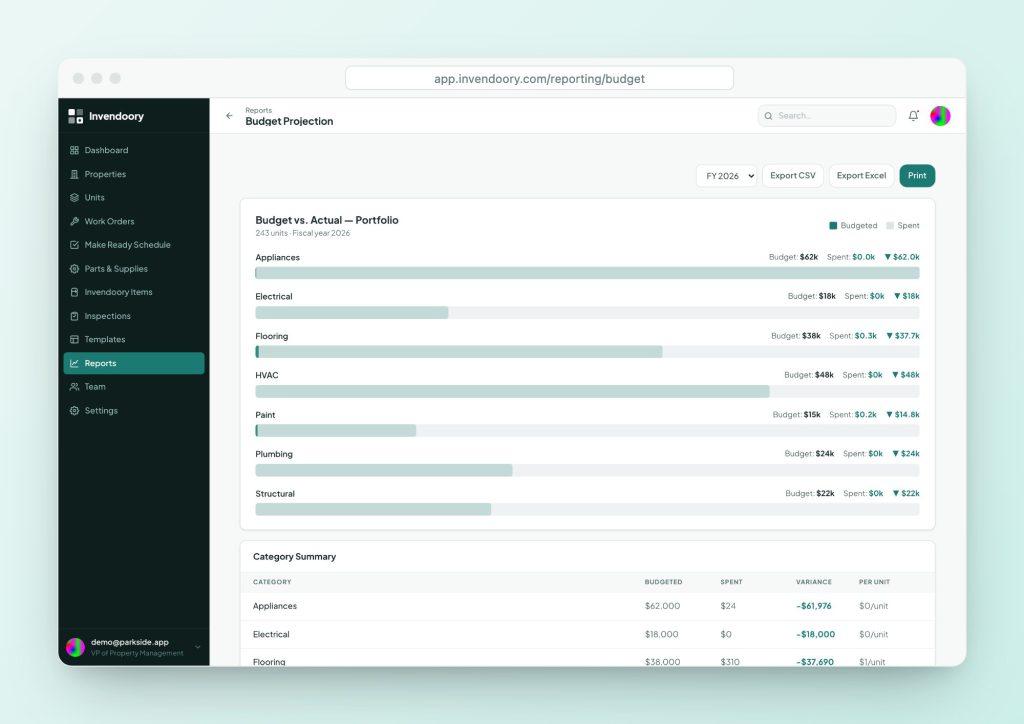
Budget Projection lines up budget against recorded spend for each category and fiscal year, with the variance and the cost per unit. Cost per unit matters because a 300-unit property and an 80-unit one cannot be compared in dollars. The maintenance KPIs guide covers repairs and maintenance cost per unit and parts spend per unit in more detail.
Budget targets are brought in through data import, since Invendoory has no in-app budget editor, and your approved budget stays wherever your finance team keeps it. Invendoory has no accounting sync, so the actuals are the spend recorded in the app.
The app sends a notification when a category reaches 80% and again at 100%, so you hear before the overrun. Every report exports to CSV and Excel.
- Budget, actual, variance and cost per unit
- Fiscal-year view by category
- Notifications at 80% and 100%
Checking spend against what is installed
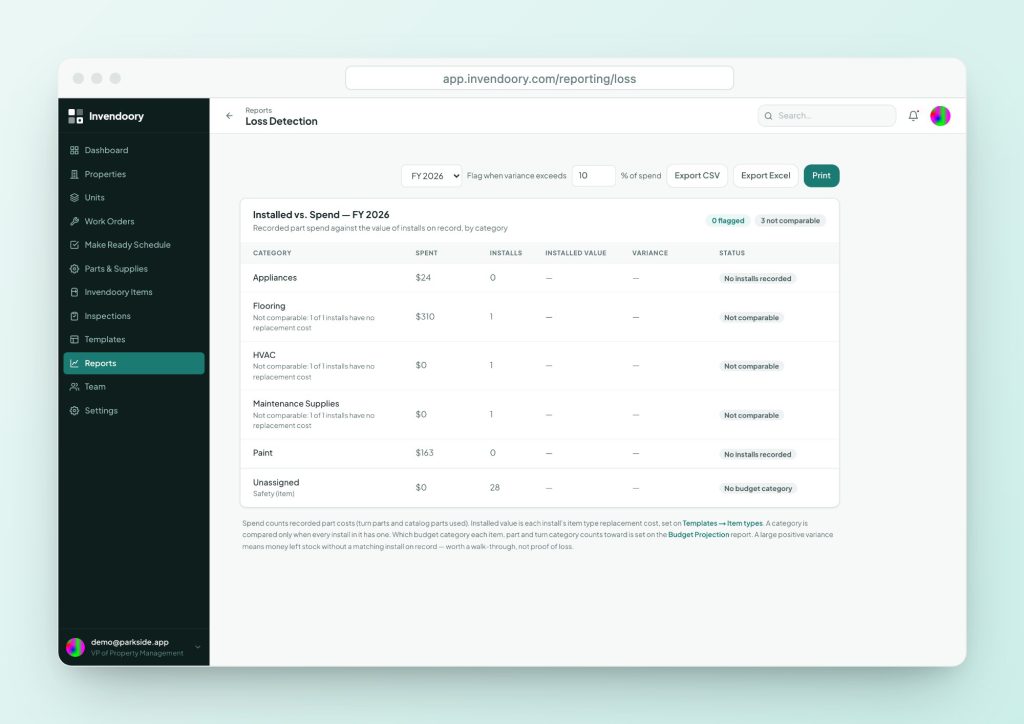
Regional managers and VPs have a second question: does the spend match the work? Loss Detection sets recorded spend beside the value of the items installed in each budget category, and flags the category when the gap goes above a threshold. Only the VP role sees it.
A flag is a reason to ask, not a finding. It does not detect theft, and it cannot know about an item nobody recorded. It can point you to a category where the spend and the installed record have drifted apart, whether from a recording problem, a pricing problem or a process problem.
It works because verified turns and completed replacements write new installs back to each unit, so the installed value moves as real work is done.
- Recorded spend vs installed value by category
- Flag above a variance threshold
- VP role only
Budget variance questions
How much variance is acceptable?
There is no universal number. Many teams set a threshold, such as 5% or 10% of a line or a dollar amount, and require an explanation above it. Pick a rule that fits your portfolio, apply it the same way everywhere and review it each year.
Is a favorable variance always good?
No. Underspending can mean good control, or work being put off that will cost more later. Check the inspection results and open work orders behind a favorable line before you celebrate. A low number can be a warning.
How is a repairs and maintenance budget set?
Usually from last year’s actuals, adjusted for turn volume, known contracts, aging equipment and price changes. An item-level inventory with remaining life improves the equipment part of the forecast. Your owner or lender may also set requirements.
Should capital replacements be in the R&M budget?
It depends on your accounting policy, tax treatment and lender requirements. IRS Publication 527 distinguishes repairs from improvements that must be capitalized. Write a clear threshold and apply it consistently, and confirm the treatment with your CPA.
Does Invendoory sync with our accounting system?
No. Budget targets come in through data import, and Invendoory compares them with spend recorded in the app. It is a working view for managers, regionals and VPs, not an accounting system, so your books remain the record of truth for financial reporting.
Sources
- IRS Publication 527, Residential Rental Property (Repairs vs improvements. Confirm treatment with a CPA.)
Checked October 2026.