Centralized maintenance pulls triage, scheduling and some of the repair work out of each property and runs it for a group of nearby communities. It can work well. It also fails quietly when the basics are missing.
What centralized maintenance means
In the traditional model, each apartment community has its own maintenance team sized to its unit count. Centralized maintenance breaks that link. A shared team serves several properties, and requests are triaged and dispatched from one place.
Multifamily Dive describes one operator that puts four or five properties within a 10-mile radius into a single maintenance pod. Tickets go to the nearest qualified technician. Others centralize only the front end, such as triage by a call center, and keep technicians on site.
So the term covers a range. You can share the phone line, the schedule, the specialists, or the whole crew.
Why multifamily maintenance is moving this way
Maintenance is the hardest on-site role to fill. A June 2026 Multifamily Dive report, citing the NAA’s Apartment Market Pulse, says operators must staff a growing number of communities and that skilled technicians are in short supply. Spreading a smaller team across more properties is one response.
Operators also point to specialization. A technician who does HVAC all day gets faster than a generalist who does it twice a month. Remote triage can resolve some requests without a visit.
- Fewer open technician positions to fill
- Specialists matched to the right jobs
- Admin work moved off the site team
Pros and cons of shared maintenance teams
The pros are real, but so are the costs. Be honest about both before you reorganize.
Pro: better use of skilled people
Specialists handle the work they are best at, and a request goes to whoever is closest and qualified.
Pro: lower fixed headcount
Some operators report savings from not refilling vacant positions, and use part of it to raise technician pay.
Pro: consistent standards
One set of turn templates and one triage process across communities makes quality easier to compare.
Con: less site knowledge
A technician who has never seen a building does not know which valve sticks or which tenant has a dog.
Con: needs density
Multifamily Dive notes the model needs enough properties in one market. Distant communities do not benefit.
Con: owner buy-in
Third-party managers must show that owners are billed fairly and that older properties are not subsidized by newer ones.
Centralize on purpose, not just to cut cost
Propmodo reported in November 2025 that cutting indiscriminately can backfire, because lost revenue and weaker service can outweigh the savings. Lost revenue shows up first as slower turns, which the cost of vacancy guide puts a number on, and savings only count if they hold up in a budget vs actual review. Its guidance for maintenance is that centralization works best when properties are clustered in the same submarket, and that the goal is to free crews for resident-facing work.
The distinction is practical. Centralizing paperwork and scheduling is easy to defend. Centralizing the person who knows the building is harder.
What shared multifamily maintenance requires
Four things have to be true before a shared team works.
1. Shared parts
A technician driving between buildings needs to know what is on the van and what is on each shelf, and what a part costs.
2. Standard templates
The same turn checklist and inspection form at every property, so a visiting technician knows what done looks like.
3. Clear assignment
Every request has one owner and a due date, and everyone sees who has it.
4. Visibility
A supervisor sees open work, aging and results across properties without calling each site.
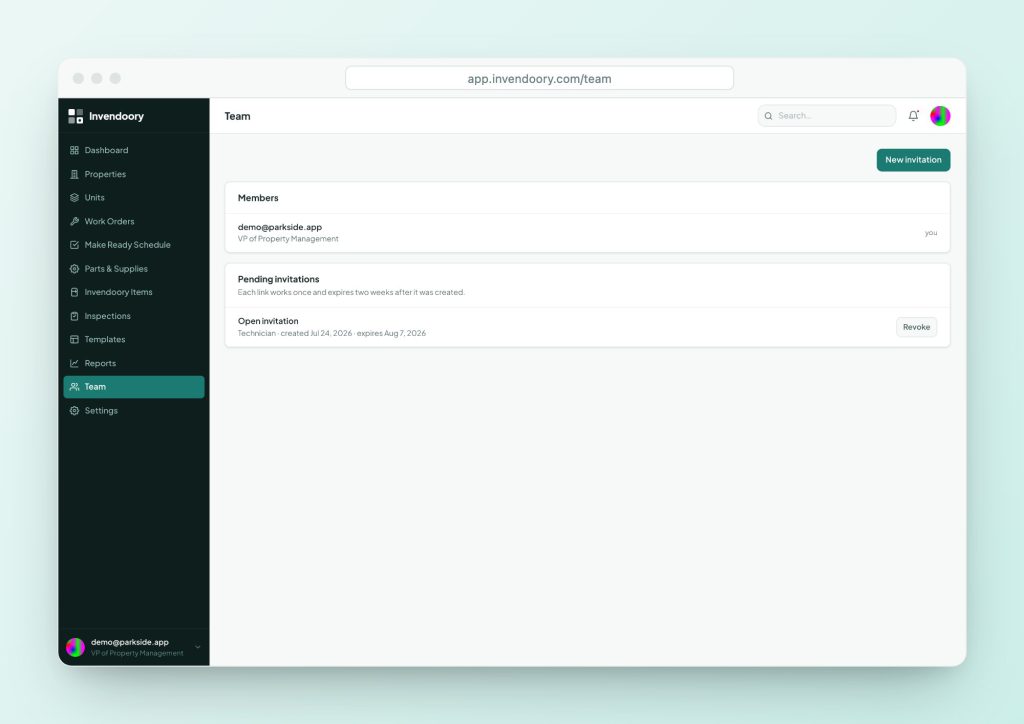
Assignment, templates and parts in one place
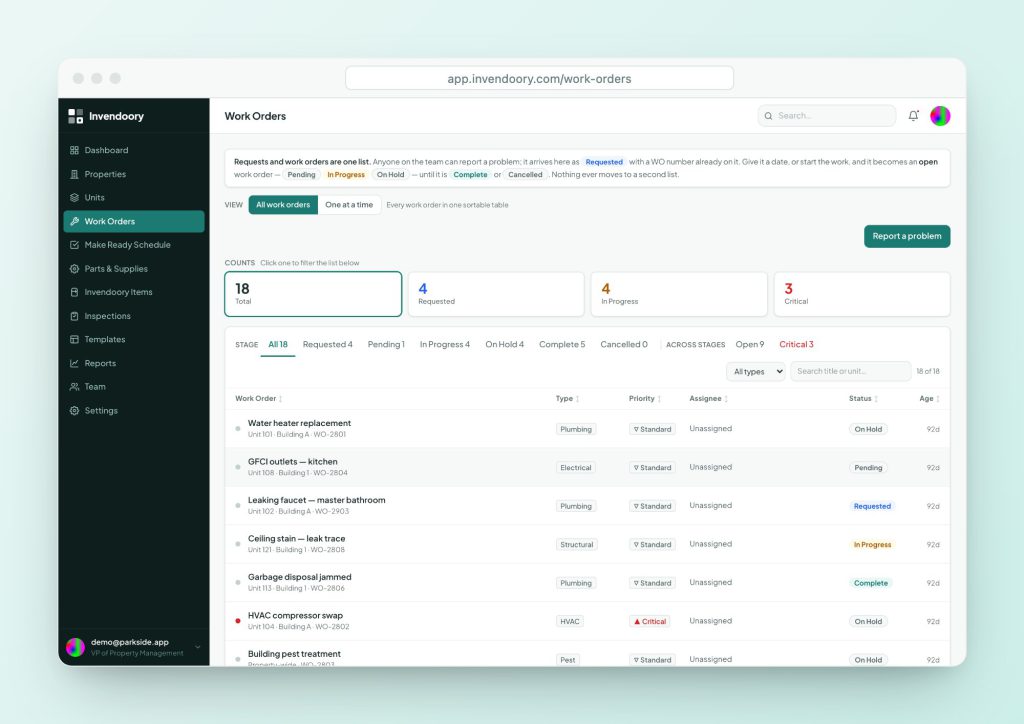
Work orders and requests share one lifecycle: Requested, Pending, In Progress, On Hold, Complete. A supervisor triages and assigns, and every order links to the unit and the specific appliance, with an audited activity history. See work orders for the full flow.
The Parts & Supplies catalog tracks stock on hand with low-stock alerts, and every appliance’s detail panel shows compatible parts. Turn templates and Make Ready templates let each property start from the same task list.
- One list of requests and work orders
- Compatible parts shown on the item
- Turn templates reused across properties
See the whole portfolio, then one property
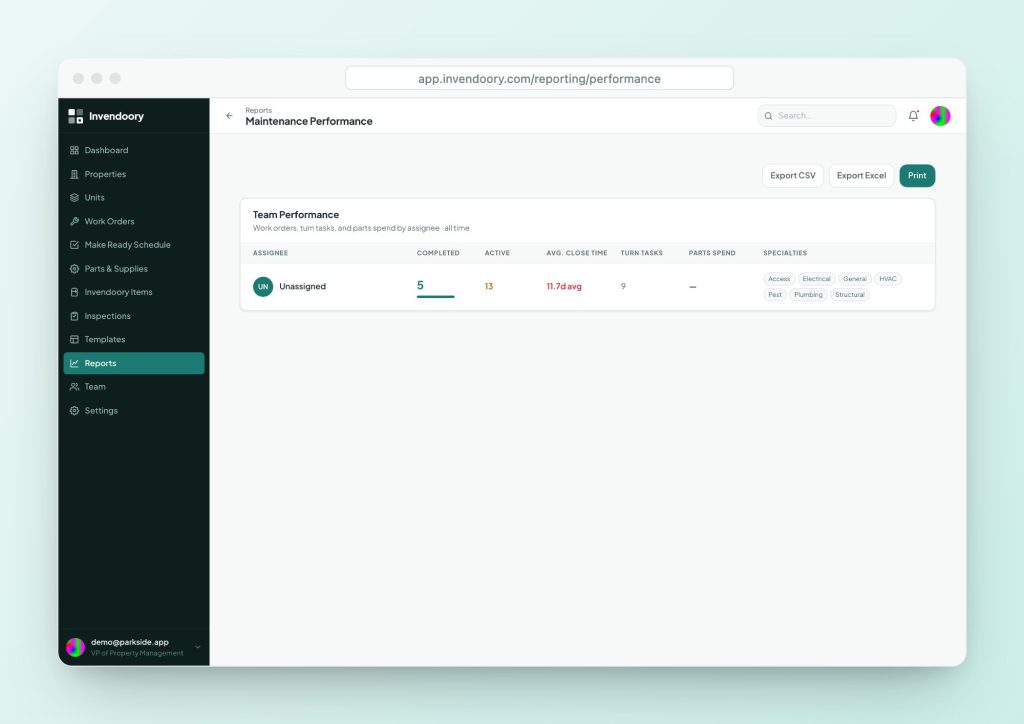
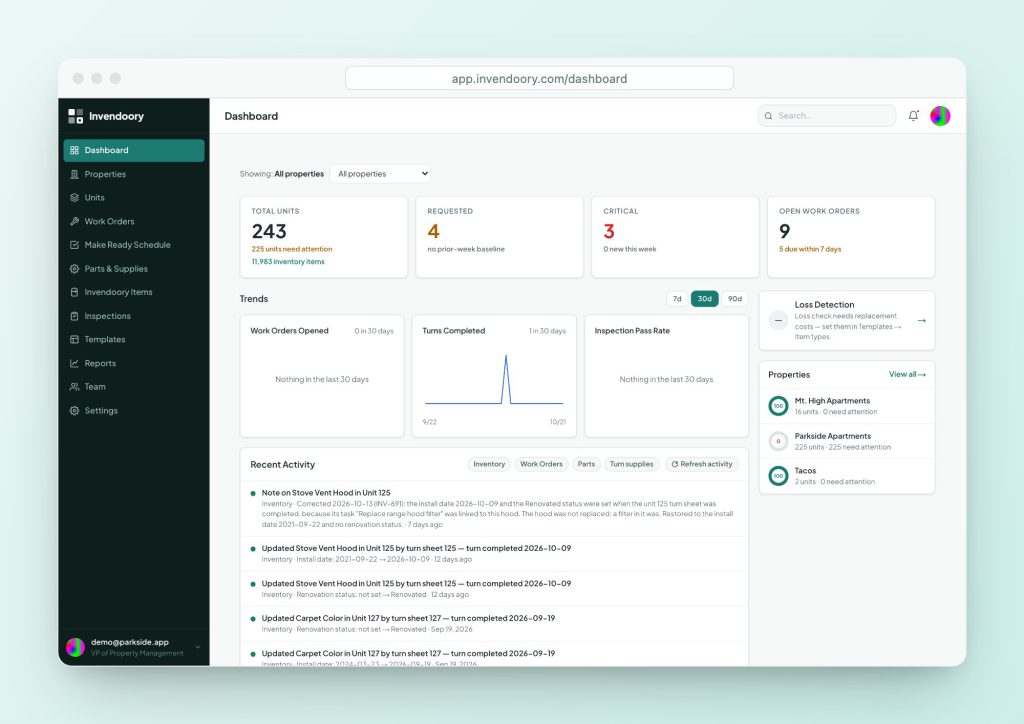
The dashboard has a property scope selector for all properties or one. Cards for Requested, Critical and Open Work Orders click through to the exact rows behind each number.
The Maintenance Performance report shows, per technician, completed and active work orders, average close time, turn tasks and parts spend. Use it to see whether the shared model is working, not to rank people on a single number. Supervisors can start at the maintenance supervisor page.
- Property scope selector on the dashboard
- Per-technician completed, active and average close time
- Clicks through to the rows behind each number
How to pilot a shared team
Pick two or three communities in the same area. Standardize their turn templates first. Move triage and scheduling to one person, and keep a technician on each site for the first quarter.
Track four numbers before and after: open work order age, average close time, make ready days and first-time fix. Review them with the site managers, not only the regional. If the numbers do not move, or the site managers say service got worse, fix the process before adding more properties.
Centralized maintenance questions
Is centralized maintenance the same as outsourcing?
No. Centralized maintenance usually means your own employees serve several of your properties from a shared hub. Outsourcing hands the work to a vendor. Some operators combine both, using contractors for specialized trades and a central team for routine work.
How many properties should share a team?
There is no standard number. Operators describe pods of four or five communities within about 10 miles. Density matters more than the count, because drive time eats the benefit. Start with a pilot and measure.
Does it replace on-site technicians?
Not entirely. Remote triage can resolve some requests, but many problems need someone in the unit. Most operators keep some site presence or rely on fast dispatch, and the right mix depends on your market.
What breaks first?
Usually parts and knowledge. A visiting technician arrives without the right part or does not know the building. Shared parts records, item details on the phone and standard templates reduce both problems.
Which metrics show whether it works?
Watch open work order aging, average close time, make ready days and resident satisfaction. Compare them to the months before the change. Our maintenance KPIs guide explains how to calculate each.
Sources
- Multifamily Dive on centralized maintenance and service pods (Aug. 20, 2024) (Pod model, 10-mile radius, benefits and challenges.)
- Multifamily Dive on multifamily maintenance staffing (June 30, 2026) (Cites NAA Apartment Market Pulse, Q1 2026.)
- Propmodo: There Is a Right and a Wrong Way to Centralize Multifamily Operations (Nov. 3, 2025) (Risks of cutting too deep; clustered submarkets.)
Checked October 2026.