
Property operations is everything it takes to run an apartment community day to day, from leasing a unit to fixing a faucet to reporting results to the owner. This guide maps the pieces and the people.
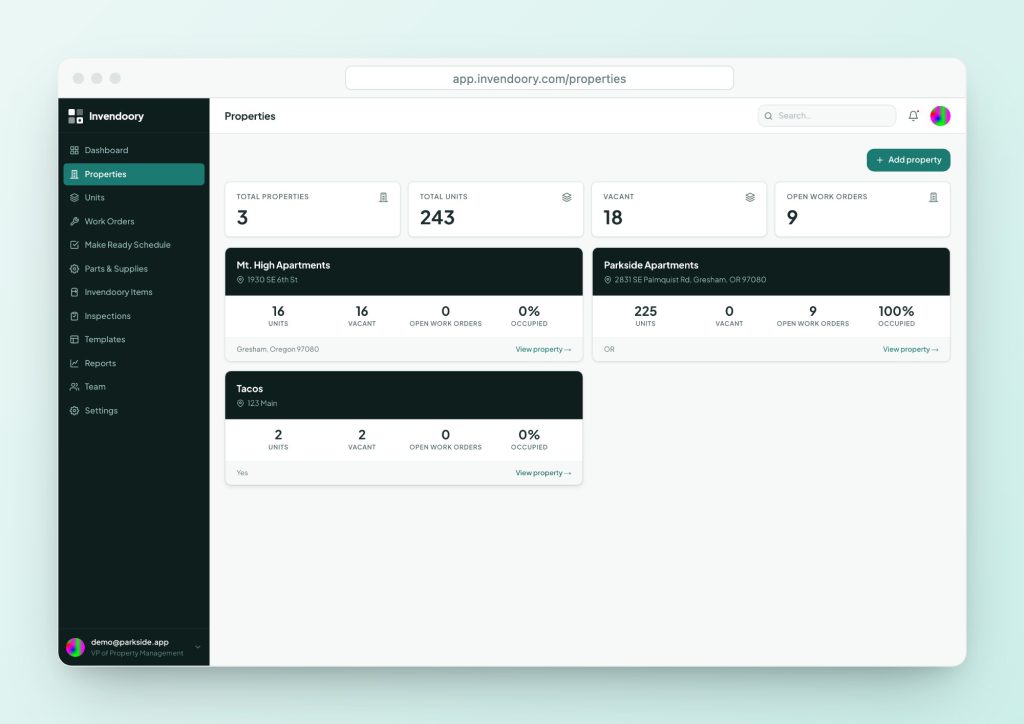
What property operations means in apartments
In multifamily, property operations means the daily work of running a community so it earns income and keeps residents. The Bureau of Labor Statistics sorts a property manager’s duties into three groups: money, upkeep and the people who live in the property.
Those groups map to four areas most apartment teams recognize: leasing, maintenance, resident services and financial performance. Multifamily operations is how those four fit together. A slow turn costs leasing a move-in. A missed work order hurts renewals. A budget overrun shows up in the owner’s report.
Titles vary by company, so use the roles below as a guide, not a rule.
What property operations covers
Each area has its own owner and its own numbers.
Leasing
Marketing vacant units, showing them, explaining lease terms and following fair housing law. The key numbers are occupancy, leads and days vacant.
Maintenance
Inspecting grounds, buildings and equipment, arranging repairs and turning units between residents. The key numbers are work order completion time and make ready days.
Resident services
Responding to repair requests, handling complaints and disturbances, and enforcing lease terms. The key numbers are response time and renewals.
Financial performance
Collecting rent, paying bills, preparing budgets and reporting occupancy and results to the owner. The key numbers are NOI, budget variance and cost per unit. See budget vs actual for how to read the variance.
Who is who on a property operations team
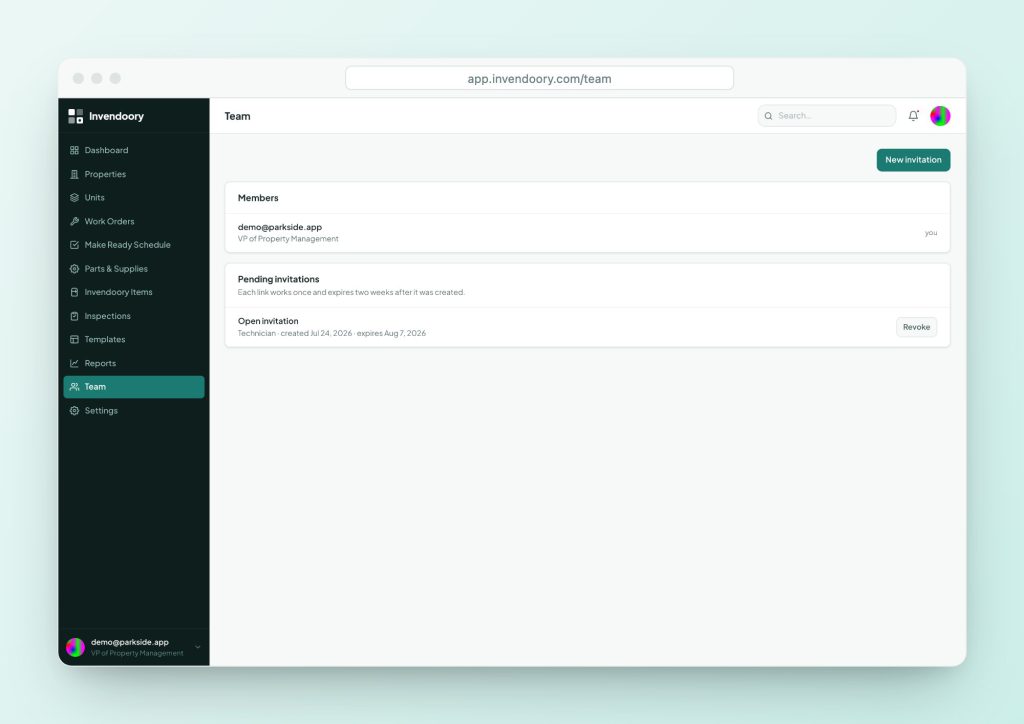
A property operations manager, sometimes called a community or site manager, runs one property. Leasing consultants work with prospects and new residents. A maintenance supervisor leads the technicians and owns turns, work orders and parts.
Above the site, a regional manager oversees several communities, and a vice president oversees the regionals. The BLS reports about 460,400 property, real estate and community association manager jobs in 2025, with median pay of $69,990, so this is a large profession with many titles.
- Site or community manager: one property, all four areas
- Maintenance supervisor: technicians, turns, parts
- Regional manager and VP: portfolio results
Who owns what in multifamily operations
A rough division of labor. Your org chart may differ.
| Role | Main focus | Cares most about |
|---|---|---|
| Property manager | Budget, residents, leasing, vacancy | Occupancy and cost control |
| Maintenance supervisor | Work orders, turns, inspections, parts | On-time turns and a crew that isn’t buried |
| Maintenance technician | Doing the repair or turn task | Fixing it in one trip |
| Regional manager | Several communities | Consistent results, fewer surprises |
| VP | Portfolio value and performance | Cost control and team performance |
These match the six roles in Invendoory: Leasing, Technician, Maintenance Supervisor, Property Manager, Regional Manager and VP.
Where multifamily operations breaks down
Most problems in apartment operations happen at handoffs, not inside one job. A resident reports a leak to the office, the office tells maintenance, and maintenance tells the resident. Each step is a chance to lose the details.
The same is true of a move-out. Leasing knows the date, maintenance learns it later, and the vendor learns it last. Every extra day between those handoffs is a vacant day.
The fix is rarely a new job title. It is a shared record that everyone reads from, and a clear owner for each step. A property operations manager who can see the open requests and the turn schedule on one screen spends less time chasing updates.
That is also what makes a portfolio comparable. When every community logs work the same way, a regional can ask a sharper question than “how is the site doing?”
Maintenance data connects the four areas
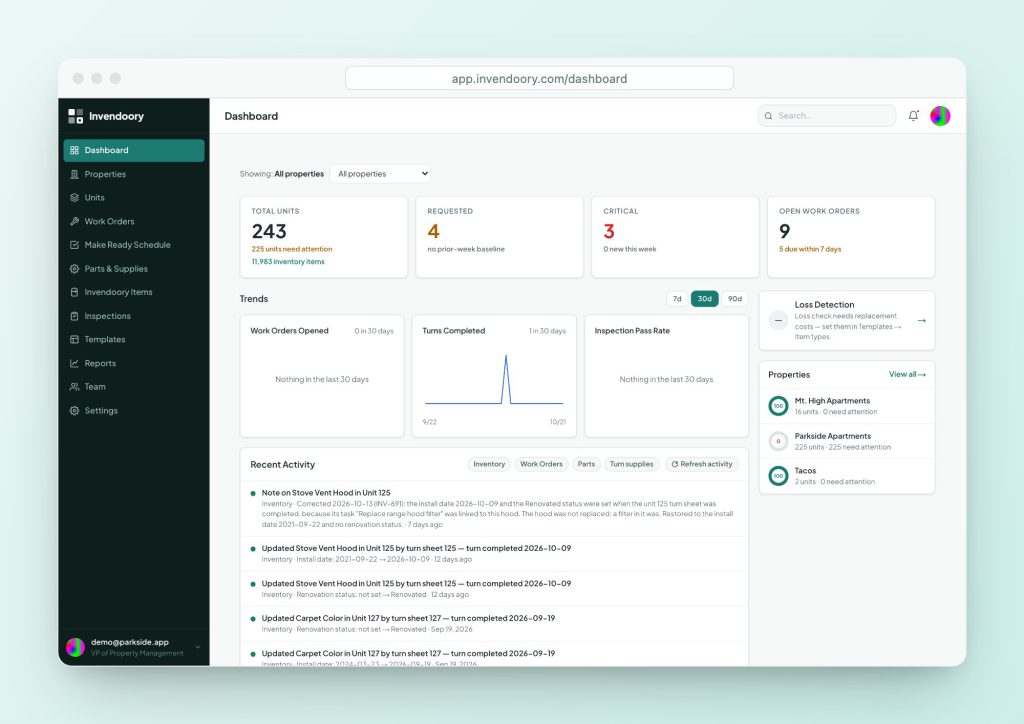
Maintenance generates the data the other three areas depend on. Make ready speed decides how many days a unit is vacant, which is where vacancy loss comes from. Work order history shows which buildings are costing money. An item-level inventory with ages tells finance what is due for replacement.
In Invendoory, work orders, turns, inspections and the unit record share one system. Leasing can file a request. Supervisors triage and assign. Managers verify turns. Regionals and VPs see the same numbers rolled up. See work orders for the day-to-day flow.
- Turns feed leasing’s move-in dates
- Work orders show where repair spend goes
- Inventory ages feed capital planning
What regionals and VPs need from operations data
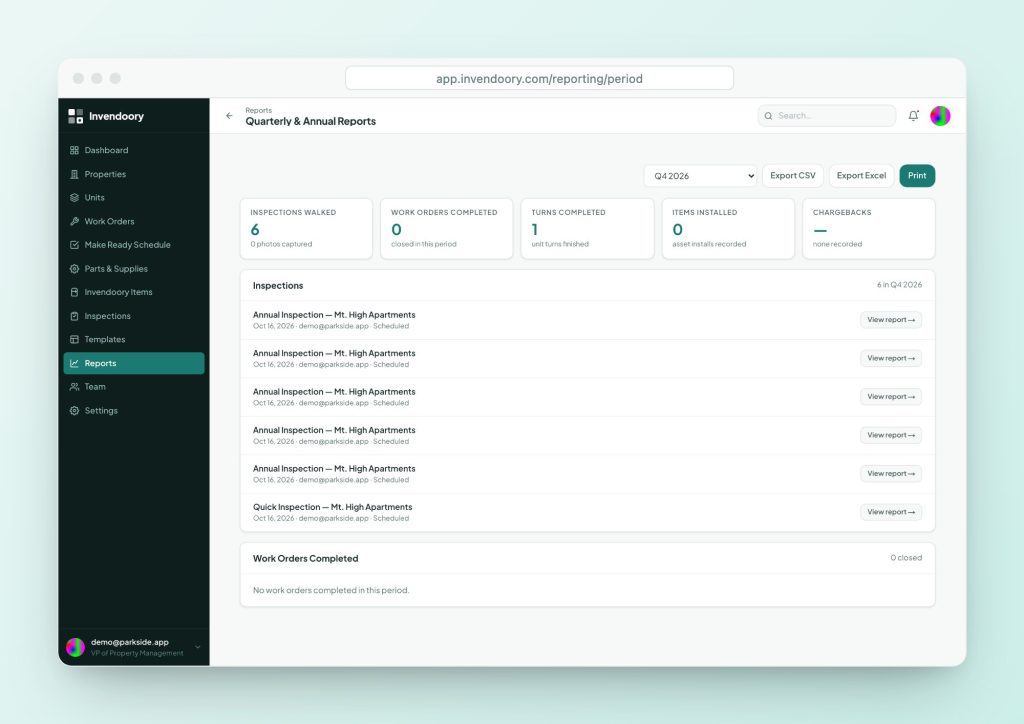
A regional manager needs to compare communities on the same terms. That means the same definitions, the same reports and the same period. The Quarterly & Annual Reports give inspections walked, work orders and turns completed, items installed and chargebacks for a period.
VPs also get Loss Detection, which compares recorded spend to installed value by budget category. It is visible only to the VP role. See the regional and VP page for how those roles use the platform.
- Same definitions across communities
- Maintenance Performance per technician
- Loss Detection visible to the VP role
Why operators are rethinking how work is shared
Maintenance is the hardest on-site role to fill, according to a June 2026 Multifamily Dive report that cites the NAA’s Apartment Market Pulse. Leasing and other operations roles have become easier to fill. Some operators respond by moving administrative work to central teams and using technology to cut paperwork for technicians.
If you are weighing that, read our guide on centralized maintenance. The short version is to centralize paperwork first and the person who knows the building last.
Property operations questions
What does a property operations manager do?
Titles vary, but the job usually covers a property or group of properties: leasing and occupancy, maintenance and turns, resident issues, and budgets and reporting to the owner. At some companies it is the site manager. At others it is a role above site managers.
How is property operations different from asset management?
Operations runs the community day to day. Asset management is about the property’s value and return for the owner, and it relies on operations data. Many companies have both, and the two roles meet in budgets, capital plans and reports.
What are the main operations metrics?
Occupancy, days vacant, make ready days, work order completion time, renewals, budget variance and cost per unit. Our maintenance KPIs guide covers the maintenance ones with formulas.
Where does maintenance fit in operations?
It is one of the four areas, and it touches the other three. Maintenance sets how quickly vacant units return to leasing, how residents experience service, and a large share of the expense budget.
Does Invendoory replace our property management system?
No. Invendoory handles inventory, inspections, turns, work orders and parts. It is not a leasing or accounting system. It imports units from your system’s exported spreadsheet and builds the maintenance record from there.
Sources
- U.S. Bureau of Labor Statistics: Property, Real Estate, and Community Association Managers, Occupational Outlook Handbook (Duties by financial, maintenance, leasing and resident groups; 2025 employment and median pay.)
- Multifamily Dive on multifamily maintenance staffing (June 30, 2026) (Cites NAA Apartment Market Pulse, Q1 2026; maintenance hiring and centralization.)
Checked October 2026.