The make ready meaning in apartments is simple: the work that gets a vacant unit rentable again. This guide covers the make ready process step by step, who does what, and how long it should take.
Make ready meaning in apartments: what the work covers
Make ready is the physical work done on a vacant apartment between one resident leaving and the next one moving in. It covers the inspection after move-out, trash removal, repairs, paint, cleaning, flooring and a final check.
People searching for the make ready meaning usually want to know where it sits next to the word “turnover.” The National Apartment Association (NAA) defines apartment turnover as the process of preparing a vacant apartment home for a new resident to move in. Make ready is the maintenance side of that process. Turnover also includes marketing, leasing and paperwork. If you hear “turn,” “make ready” and “make-ready” used as the same thing on a maintenance crew, that is normal. This guide uses “turn” for the whole job and “make ready” for the unit prep.
The make ready process, step by step
The NAA describes the apartment make ready process as a sequence. Technicians inspect the unit after move-out to decide what work is needed. They remove trash, change the lock to a vacant lock and paint. Then come maintenance repairs, general cleaning and carpet cleaning or replacement. A final inspection confirms the unit is ready.
The order matters. Paint before carpet. Clean after the dust-making work is finished. Inspect last, with a checklist, not from memory. The apartment make ready checklist lays out every room.
- Walk the unit and list the work
- Trash out, vacant lock, paint
- Repairs, cleaning, flooring
- Final inspection before it is rent ready
Who does what in an apartment make ready
Crews differ on who paints or cleans, since some properties use contractors for part of the work. The jobs stay the same.
| Role | Job in the make ready process |
|---|---|
| Maintenance technician | Walks the unit, does the repairs, paint touch-ups and appliance swaps, and records what went in |
| Maintenance supervisor | Builds the turn schedule, assigns tasks, orders parts and supplies, and keeps the due date |
| Cleaning and carpet vendors | Clean and shampoo or replace flooring once the dirty work is done |
| Property manager | Does the final walk and signs the unit off as ready to rent |
| Leasing | Needs a reliable ready date so the unit can be shown and leased |
How long should a make ready take?
There is no universal number. The NAA says the time depends on the age of the community, how long the last resident lived there, the unit’s condition at move-out and how the community organizes its turns. Many companies use seven working days as an average guideline. Management groups often expect five working days, and sometimes only three.
The NAA also cites its 2019 Survey of Operating Income & Expenses: average turnover across apartment rentals was 46.8 percent, and the average cost of a single move-out was conservatively calculated at $1,800. Your own cost will differ with unit size, finish level and local labor rates. The point of the number is that every extra vacant day adds vacancy loss on top of the cost of the work.
Five habits that shorten a make ready
1. Inspect before move-out
The NAA recommends a pre-move-out inspection, ideally within a week of notice, so parts and contractors are ordered before the unit is empty.
2. Use one checklist
The same list for every unit means nothing is skipped and nobody is guessing what “ready” means.
3. Stock the shelf
A tech who has to leave the unit for a missing switch plate loses an hour. A standard supply list prevents that. See maintenance supplies list.
4. Show status
A make ready board shows every unit’s progress at a glance. See the make ready board guide.
5. Verify at the end
One person checks the finished unit before it goes back on the market.
How Invendoory runs the make ready process
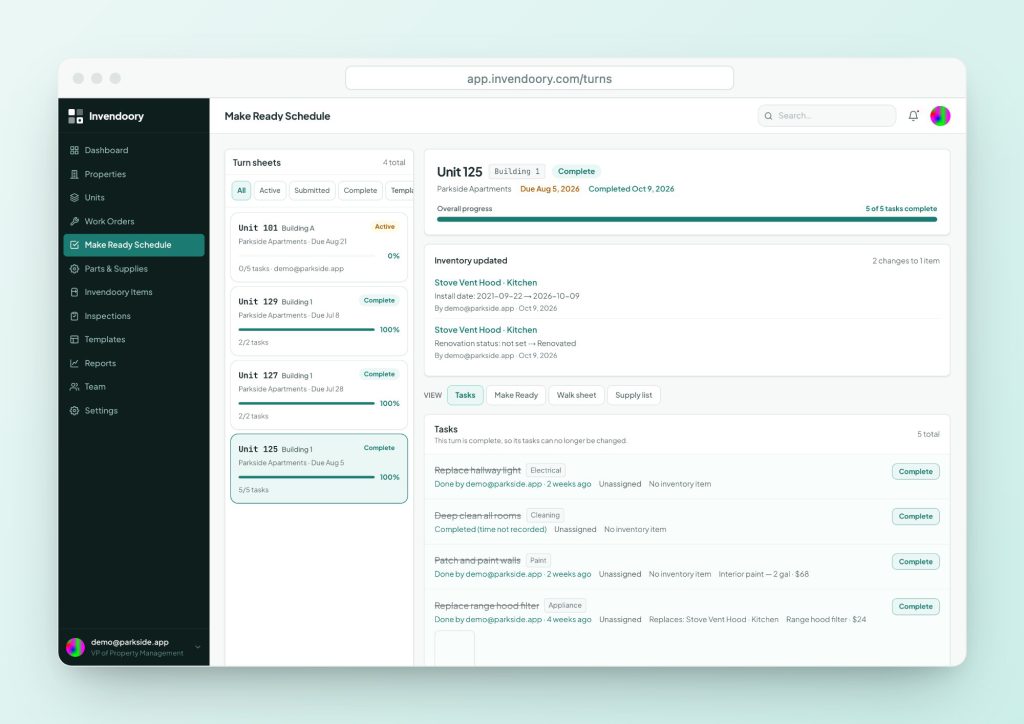
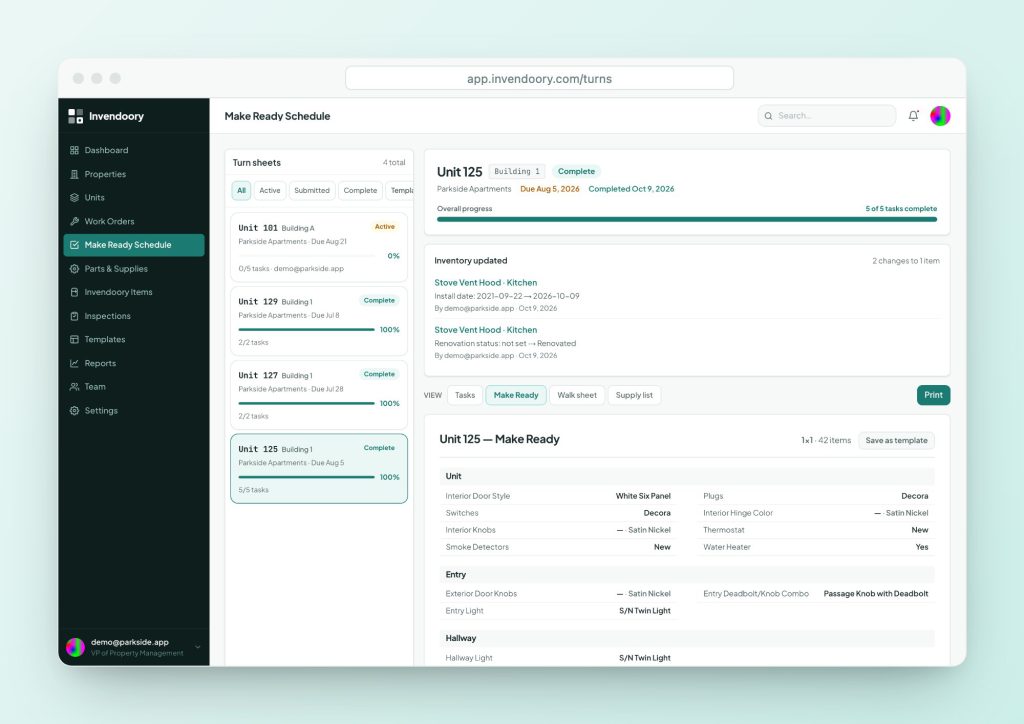
Invendoory gives every vacant unit one turn sheet with a due date and assigned tasks. You can start the sheet from a turn template (a reusable task list) or from a Make Ready template, a room-by-room spec captured from a real unit. Techs work their tasks on their phones, add notes and photos, and mark each item Replaced or Serviced.
When a tech finishes, they turn the sheet in. A property manager verifies it, or sends it back with a reason. Verification takes the used supplies out of stock and writes replaced items into the unit’s inventory. The sheet then shows Inventory updated. Read more on the Make Ready platform page.
- One turn sheet per unit, with a due date
- Techs turn in, a manager verifies or sends back
- Inventory updates itself on verify
Make ready versus the rest of turnover
Turnover starts when a resident gives notice and ends when the next resident takes possession. It covers marketing the unit, screening applicants, signing a lease, the move-out inspection and the deposit accounting. Make ready sits inside it.
That split explains why make ready feels like a maintenance problem and a leasing problem at once. Leasing needs a date. Maintenance needs access, parts and time. A shared schedule is what reconciles the two. If the move-out inspection finds damage, the charge calculation belongs to the property manager, and the move-out charge calculator shows how age and condition change what a resident owes. For the inspection forms themselves, see the move-in and move-out inspection checklist.
Questions people ask
What is the difference between make ready and turnover?
Turnover is the whole cycle from notice to the next move-in, including marketing and leasing. Make ready is the physical preparation of the unit inside that cycle: inspection, repairs, paint, cleaning and final check. Crews often use the words interchangeably.
What is the make ready meaning for a new maintenance tech?
It means the work you do on a vacant unit so it can be rented again. You inspect it, fix or replace what is broken, paint, clean and check your work. Each unit has a due date, and the leasing office is waiting on it.
How many days does an apartment make ready take?
It varies. The NAA reports that many companies use seven working days as an average guideline, with five or even three working days expected by some management groups. Condition at move-out and whether contractors are used change the answer a lot.
Is make ready the same as a unit turn?
In day-to-day speech, yes. A “turn” and a “make ready” both mean getting a vacant apartment ready for the next resident. In formal terms, turnover is broader and make ready is the unit-prep part.
What is a make ready board?
It is a whiteboard or digital board that shows the status of every vacant or soon-to-be-vacant unit. The NAA describes it as a tool techs and office staff use to track the tasks needed to restore an apartment after move-out.
Can software replace the paper make ready sheet?
It can. In Invendoory the turn sheet holds the tasks, notes, photos and supplies, and a printable walk sheet remains available for crews that want paper. Verification then updates the unit’s inventory.
Sources
Checked October 2026.