
Use this preventive maintenance checklist to schedule monthly, quarterly, seasonal and annual tasks across buildings, grounds and units. It is a printable apartment maintenance checklist you can adapt to your property.
Why an apartment maintenance checklist pays for itself
Preventive maintenance is scheduled work that catches wear before it becomes an emergency: the filter changed before the blower motor burns out, the smoke alarm tested before the inspector tests it for you. The NAA’s turnover guidance makes the same point: a steady schedule of weekly, monthly, quarterly and annual tasks reduces repairs at turn and helps maintenance staff manage their daily workload.
This apartment preventive maintenance checklist groups tasks by how often they come up. The intervals are starting points. Manufacturer instructions, local code, your insurer and the age of your equipment can all shorten them, so adjust before you adopt the list. Work at turn has its own list, the apartment make ready checklist.
Print this page. The site prints cleanly, so the tables work as worksheets. Initial and date each line, and keep the sheets with your maintenance records.
Monthly tasks
| Done | Task | Notes |
|---|---|---|
| ☐ | Test smoke alarms and carbon monoxide alarms in common areas and vacant units | NFPA says to test smoke alarms at least monthly. Occupied units are usually the resident’s job, so confirm your lease and local rules. |
| ☐ | Check fire extinguishers | Visual check: pressure gauge in the green, pin and seal in place, no damage, tag current. OSHA requires monthly visual checks and an annual maintenance check where an employer provides extinguishers. |
| ☐ | Walk corridors and stairwells | Burned-out bulbs, exit signs, emergency lights, damaged flooring, trip hazards, doors that don’t close. |
| ☐ | Check HVAC filters | Replace on the manufacturer’s schedule. Common-area units and heavily used systems may need monthly changes. |
| ☐ | Inspect trash areas and dumpster enclosures | Overflow, pests, odors, lids and gates. |
| ☐ | Check laundry rooms | Lint buildup, leaks, working machines, lighting. |
| ☐ | Look for leaks | Under sinks in vacant units, around water heaters, in mechanical rooms and on ceilings below roofs and balconies. |
Quarterly tasks
| Done | Task | Notes |
|---|---|---|
| ☐ | Inspect sprinkler and fire-protection equipment visually | Look for leaks, damaged heads and blocked access. Required tests follow your fire code and your contractor’s schedule. |
| ☐ | Clean refrigerator and HVAC coils in vacant units | The NAA lists coil cleaning among routine preventive tasks. |
| ☐ | Check grounds, parking and walkways | Cracks, standing water, lighting, gates, fences and signage. |
| ☐ | Inspect pool and spa areas | Signage, gates that self-close, lifesaving equipment, deck condition, logs current. |
| ☐ | Test the water heater temperature-pressure relief valve | Listed in the NAA preventive tasks. Follow the manufacturer’s procedure and wear protection. |
| ☐ | Pest control walk | Add vacant and soon-to-be-vacant units to the routine service. |
| ☐ | Run a site inspection | Score the property sections on a fixed form. See the quarterly property inspection guide. |
Seasonal tasks: spring and fall
| Done | Season | Task and notes |
|---|---|---|
| ☐ | Spring | Service cooling equipment, clear condensate lines, clean outdoor condenser coils, check window and door seals and screens. |
| ☐ | Spring | Inspect roofs, gutters, downspouts and drainage after winter. Clean gutters. |
| ☐ | Spring | Check irrigation, landscaping, grading and exterior paint or sealant. |
| ☐ | Fall | Service heating equipment before the first cold night. Test thermostats. |
| ☐ | Fall | Clean gutters again, check weatherstripping and exterior doors, drain or protect exterior hose bibs where freezing happens. |
| ☐ | Fall | Inspect boilers and chimneys, vent pipes and flues. Confirm carbon monoxide alarms. |
| ☐ | Both seasons | Replace smoke alarm batteries on a fixed date if the alarms use replaceable batteries. |
Annual tasks
| Done | Task | Notes |
|---|---|---|
| ☐ | Flush water heaters and check relief valves | The NAA lists flushing the water heater among its routine tasks. Check the setting too: CPSC recommends 120 degrees F to reduce tap-water scald risk. |
| ☐ | Clean dryer vents | NFPA says to clean lint out of the vent pipe once a year, or more often if drying takes longer than normal. Failure to clean is the leading cause of dryer fires. |
| ☐ | Have gas appliances and dryers inspected | Gas lines and connections checked by a qualified professional. |
| ☐ | Check range anti-tip brackets | CPSC says the bracket should be attached securely and the range held in it. Check on every turn and every service call. |
| ☐ | Fire extinguisher annual maintenance | Documented by a qualified vendor. Replace units that fail. |
| ☐ | Backflow and fire-system tests | Where required by your jurisdiction. Local rules vary, so confirm with your fire marshal or water utility. |
| ☐ | Inspect every unit | Walk every unit once a year. See the annual unit inspection checklist. |
| ☐ | Review replacement forecasts | List items near end of life for next year’s budget. See water heater lifespan and HVAC lifespan. |
Replace smoke alarms on the manufacture date, not the install date
NFPA says to replace all smoke alarms when they are 10 years old. The date of manufacture is printed on the back of the alarm, so look there. Put alarm age on your annual list, and pull any alarm that fails a monthly test or sounds an end-of-life chirp.
The same logic works for other equipment. A forecast of what will wear out next year is preventive maintenance for the budget.
What Invendoory does and does not do for preventive maintenance
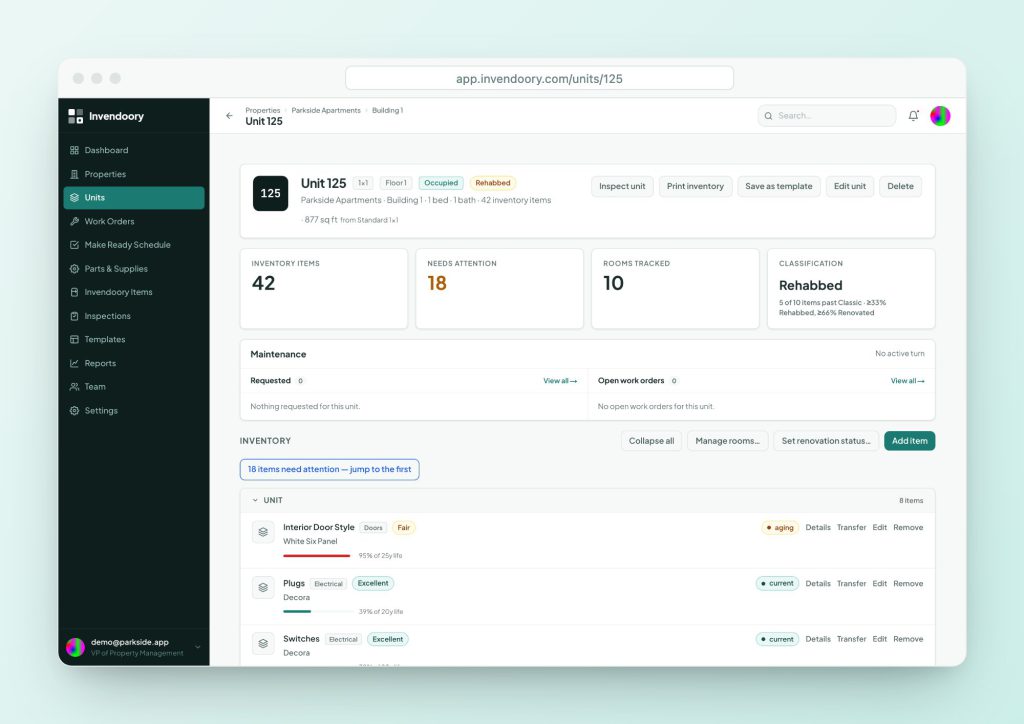
Invendoory does not generate recurring work orders on a schedule. If you want the first Monday of every month to produce a ticket, a scheduling tool will do that, and you can keep using it. What Invendoory adds is the record behind the schedule.
Every item in a unit shows install date, expected life and a life-used bar. Repair, Monitor and Replace guidance comes from fixed age and condition rules, and you get a heads-up starting 30 days before a warranty expires. Inspections, scheduled with a due date, notify managers when one is due within 7 days or overdue. See the asset inventory platform page.
- Install date, expected life and years left on every item
- Warranty heads-up 30 days before expiry
- Inspection due and overdue notices for managers
Turn recurring checks into inspection templates
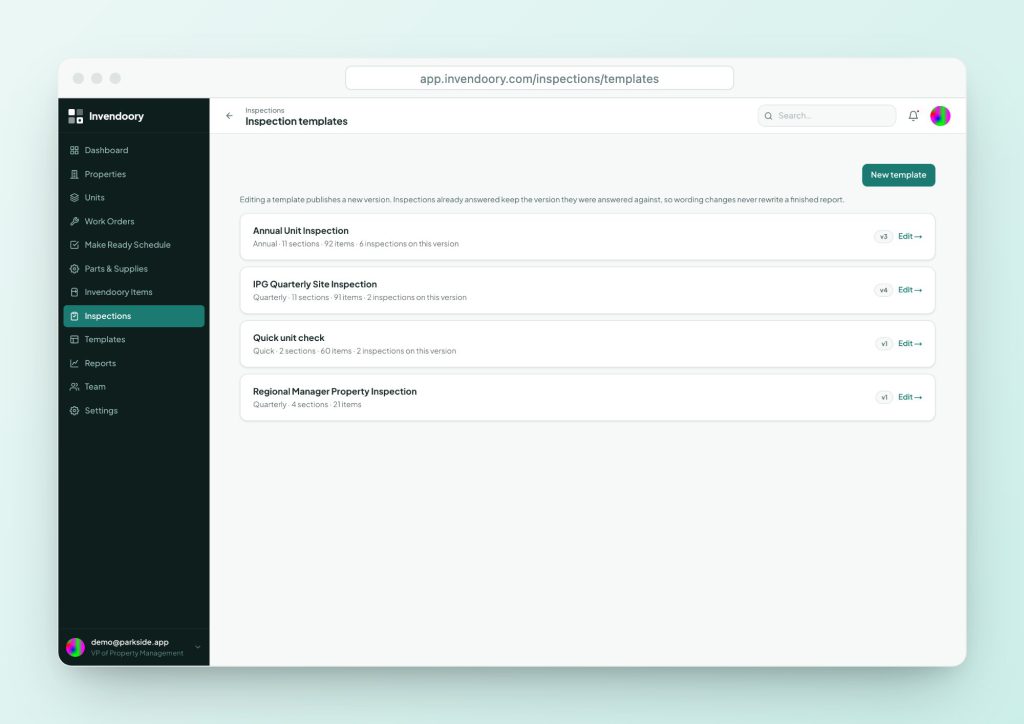
The monthly and quarterly walks above can be inspection templates: sections for the property, vacant units or occupied units, with yes/no, score, count or text answers. The app ships a Quick unit check with 30 yes/no checks across HVAC, plumbing, appliances, electrical, structure and exterior.
A failed check raises an area of concern, which one step turns into a work order or a turn task. The fix is then recorded, and a completed replacement updates the item’s record. That is the loop preventive maintenance needs: check, fix, record, forecast. See the inspections platform page.
Questions people ask
What is on a preventive maintenance checklist for apartments?
Monthly checks of life-safety gear, filters and common areas. Quarterly coil cleaning, relief valve tests and site inspections. Seasonal HVAC, roof and drainage work. Annual water heater flushing, dryer vent cleaning and a walk through every unit.
How often should smoke alarms be tested?
NFPA says to test them at least once a month and replace them when they are 10 years old, counted from the date of manufacture printed on the alarm. Check your lease and local rules for who tests alarms inside occupied units.
Does Invendoory schedule recurring work orders?
No. It does not generate recurring work orders automatically. It tracks remaining life on every item, warranty expiry dates and scheduled inspections with due-date notices, and it turns inspection concerns into work orders.
How do I decide the intervals for my property?
Start with the manufacturer’s instructions, then add local fire and health codes, insurer requirements and your own failure history. Shorten the interval for equipment that keeps failing.
What is the difference between preventive and predictive maintenance?
Preventive maintenance is done on a calendar or usage schedule. Predictive maintenance uses condition data to decide when to act. Life-used bars and condition ratings give you a simple version of the second without sensors.
Can I use this apartment maintenance checklist for a single building?
Yes. Remove tasks that don’t apply, such as pools or elevators, and add equipment you have. Keep the layout so the paper copies stay easy to scan.
Sources
- NAA, Apartment Turnover (March 2025)
- NFPA, Smoke Alarms at Home safety tips
- NFPA, Clothes Dryer Safety tips
- CPSC, Avoiding Tap Water Scalds (publication 5098)
- CPSC, Range Tipover Safety Alert (publication 5007)
- OSHA, 29 CFR 1910.157, Portable fire extinguishers
Checked October 2026.